

When our gazes meet, I sense in her the same curiosities and questions that I have within myself. Between women, sometimes just a glance is enough. She is heavily made up for what we’ve just done—false eyelashes, lipstick, foundation, blush… She adjusts her hair after getting onto the boat with the help of the man accompanying her. She wears stylish sports leggings and a somewhat retro Nike T-shirt. She smiles at me, and once everyone is on board, we cross the river to the other bank. One by one, we disembark, and some are more agile than others. “Titanic,” jokes the man steering the boat with a smile. His English isn’t great, but he wants to make us laugh.
Upon reaching the car, I see the woman putting on her long black coat over her wet clothes, adjusting her scarf, and getting back into the vehicle. Clearly, a little arrangement with tradition in order to spend the day in the Wadi, climbing rocks and descending through the natural pools of the Oasis in the middle of the desert.
Jurgen, on the other hand, is fascinated by the men in white with their embroidered kumahs, the traditional hats on their heads. Everyone here wears traditional clothing. Jurgen wonders why white is used, considering that tradition also dictates that people share a dish and eat with their hands while sitting on the floor. Not very practical, this white! It probably explains the number of laundries we’ve passed on the road. Just yesterday, by the beach at Ras al Hadd, we encountered a family. Talal, the father, offered us traditional Omani coffee. It resembles Turkish coffee, flavored with cardamom and spices. You have to drink it quickly and generally accompany it with a type of sweet pistachio paste.
We chatted with him. He was curious about our journey and eager to know more about us. Traveling for six months is very different from being mere tourists. He told us he works for the Omani Ministry of Education. He was a mathematics teacher for ten years. Now, he’s an education inspector and handles exams. He points out his son in the distance, also dressed in traditional attire. Two of his daughters have joined him, and I once again see great curiosity in the gaze of Loubnia, his eldest. I ask Talal if his son does well in school and if he likes math. “Inch’allah! Yes, he loves math. All my children are good at math,” he says proudly. “All my children” refers to the three other girls who watch us from afar, long dresses, headscarves, slender and graceful figures.
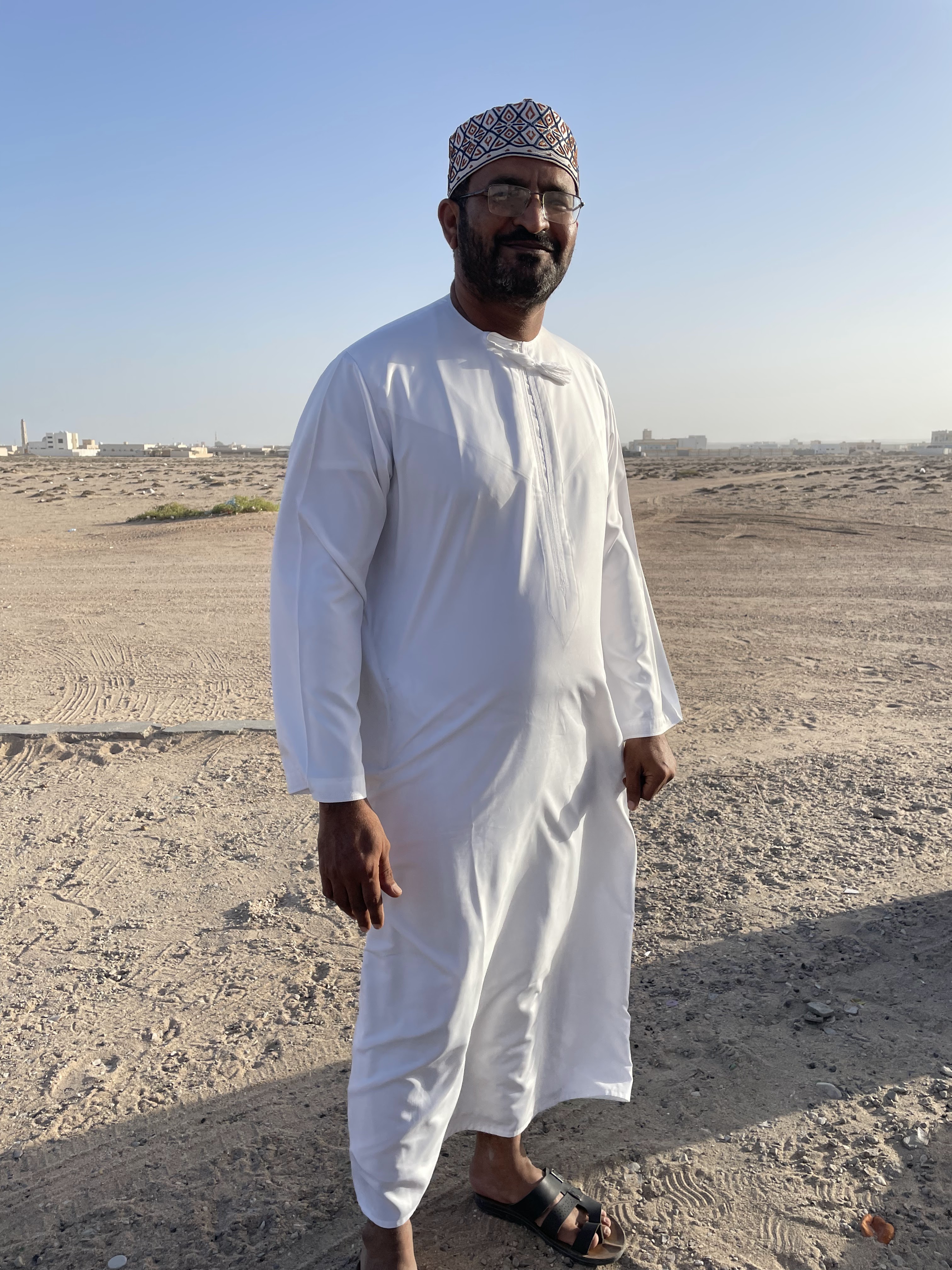
Talal leaves with his family in their 4×4 and stops to give us his mobile number. Jurgen can’t resist the urge to take a photo with him. His wife also steps down to greet me. She is completely veiled. I can only see her eyes, but they are beautiful—bright and piercing. I notice her silver high-heeled shoes and the hem of her colorful floral dress peeking out from under her black coat. She extends her hand, and we greet each other with a nod. She doesn’t see my eyes hidden behind my sunglasses. What a paradox.
Since arriving in Jordan, Dubai, or Oman, my activist and assertive mindset for women’s rights has taken a back seat. I respect the culture and the tradition of modesty and sobriety in dress applied in these countries. I veiled myself to visit the mosque and keep my eyes open to understand.
What surprises me most is the European bias I have and the fact that I know so little about Arab culture. I often have many preconceived notions and silly ideas that sometimes hit me out of nowhere. Little details remind us of this. We wonder if it’s the same place: Wadi Shab or Wadi Jab? Muscat or Masqat? How can we know when we don’t read Arabic if it’s the same place? We feel foolish when we realize that it’s only out of courtesy for those who don’t speak Arabic that they’ve transliterated the signs into the Latin alphabet, and the transcription can vary from one sign to another. In our guesthouse, Ektir takes care of us, but we had some difficulty grasping his name. Jurgen asked him to spell it for us, and he looked at us with an embarrassed expression. “For you, it could be spelled E-K-T-I-R,” he tells us. Of course, not everyone in the world uses the Latin alphabet. Even though we know this, we realize that we continue to view the world through our European lenses.
In the end, we call him Hector.
 Globetrotterdammers