

It’s nine o’clock in the evening, and the desert is quiet. The campfire is still slowly smoldering, but otherwise, it’s pitch black. In front of us, the sharp silhouette of Spitzkoppe stands out against the dark sky. Behind us, a full moon is slowly rising, casting its light over the thousands of stars scattered across the sky. The valley around us gradually begins to glow in the moonlight, as do the rocks that encircle us. An hour and a half ago, at sunset, everything was still a vivid pink-orange, but now we watch as the dark shapes slowly fade under the full moon’s glow. We’re both tired after a long day, but we want to savor this spectacle a little while longer.
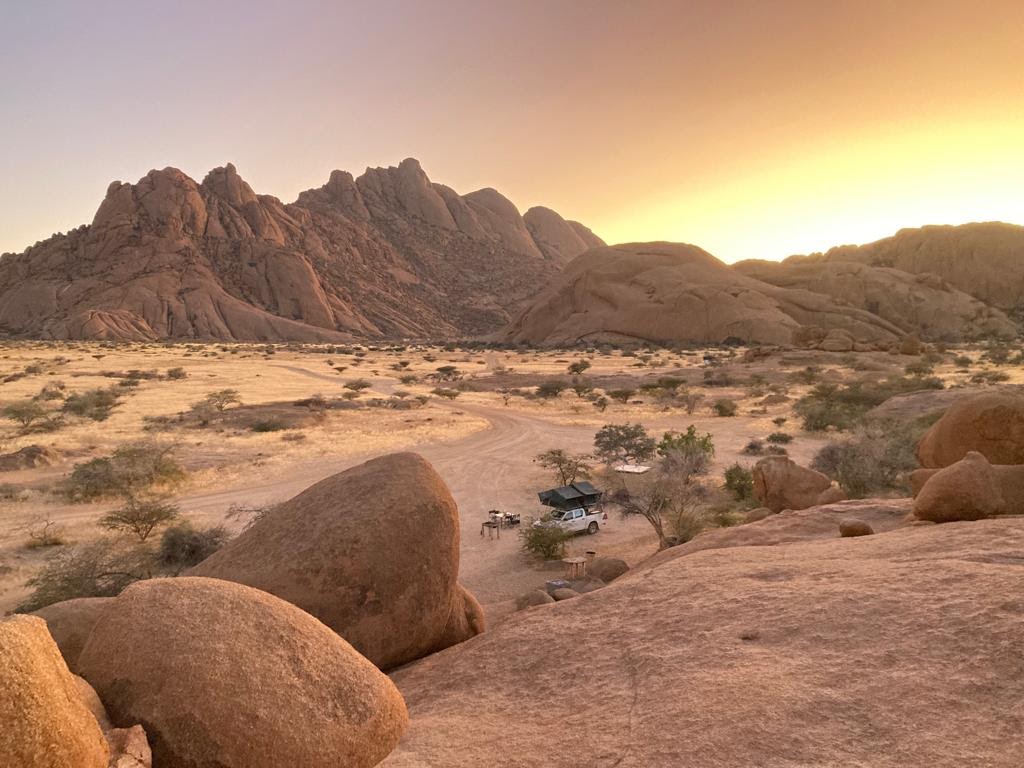
The kids have just gone to bed, and judging by their slow, steady breathing, they’re already asleep. Marie-Laure and I stand gazing upwards, wide-eyed, senses heightened. Our thoughts drift back to our first week in Namibia—a week that didn’t start smoothly and, not for the first time on this journey, called for some quick improvisation. We had just finished an exhausting three-day trip when, upon arrival, we discovered all our luggage had been lost. We were full of doubts and worries about what lay ahead. How were we supposed to cross one of the most inhospitable and sparsely populated countries in Africa without our gear? Everything we needed was in our backpacks. But we decided to embrace the situation and take things as they came. Namibia is the last country on our trip, and we were determined to make the most of it in the weeks to come, even if it meant wearing the same clothes for over a week.
Namibia is an immense country. On a map of Africa, it might not seem so large, but if you compare it to Europe, you realize just how vast it is. Arthur, who asks a thousand questions a day and won’t stop until he gets answers, soon learned that Namibia is the second least densely populated country in the world. It spans 825,000 square kilometers, roughly the size of Germany and France combined, but is home to just 2.1 million people. (“And what’s the least densely populated country then, Dad?” “Let me think… Probably Mongolia,” I replied. But Arthur wasn’t done: “What’s Mongolia like? How big is it, and how many people live there?”) This is how it often goes throughout the day. While Anna can sit quietly for hours with her nose in her e-reader, Arthur keeps firing off questions and queries, all day long. It’s adorable.
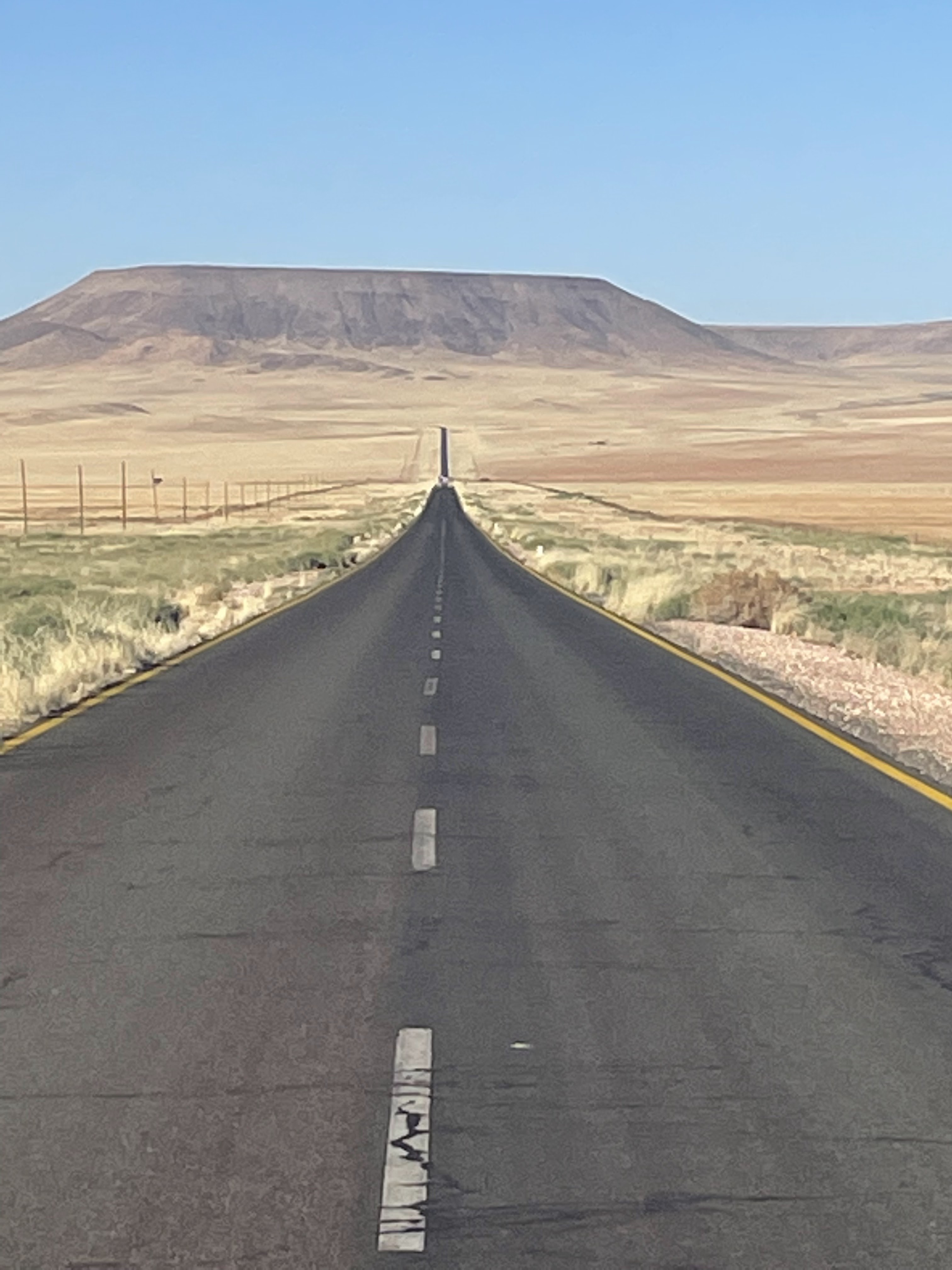
As soon as we left Windhoek, the capital, and headed south, we drove through a barren plain. Miles and miles of straight roads stretching to the horizon, surrounded by nothing but the soft, swaying, golden grass of the desert in every direction. For the first hundred kilometers, the landscape was still fairly green, and the roads were paved and in excellent condition. But after about 200 kilometers, we left the main road and entered the Kalahari Desert, where dark red sand stretched as far as the eye could see. The road became rough, with endless corrugations that shook everything in the car, making driving a challenge. We had to slow down and pay close attention. Even though we were driving a 4×4 and had lowered the tire pressure a bit, the wheels easily slipped, and a sudden turn could send us off the road due to the loose sand.
Driving in these conditions was tiring and demanded intense concentration. We kept our eyes glued to the surface of the road just ahead of the car, trying to avoid the deepest potholes, the biggest bumps, and of course, the sharp stones. The last thing we wanted was to have to change a tire in the middle of this barren plain.


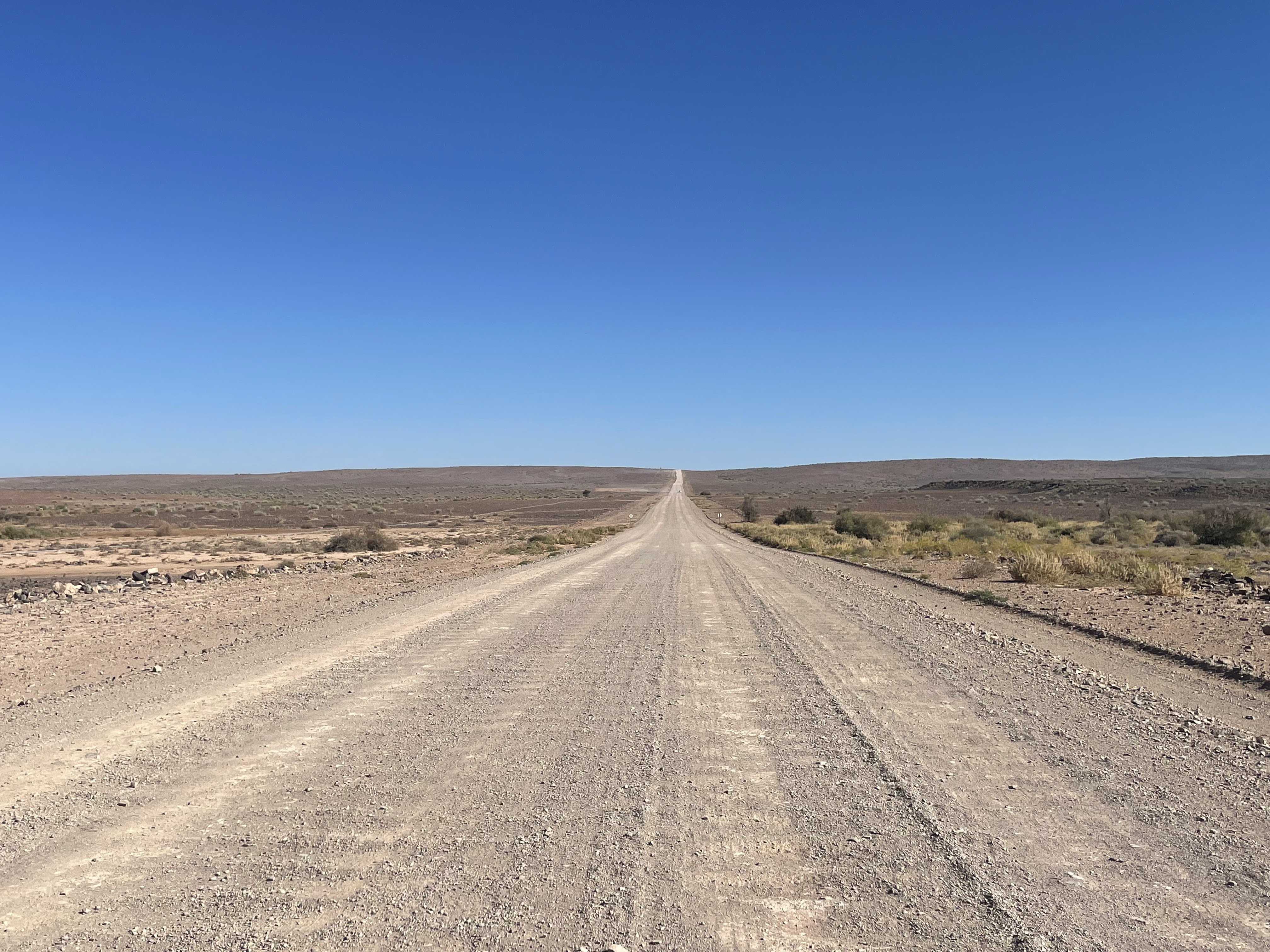

The towns along our route, like Mariental and Keetmanshoop, look significant on the map but turn out to be just small villages. With the region being so sparsely populated, we stop at every gas station we pass. We fill up the tank and refill our water bottles. If there’s a supermarket, we stock up on supplies. Everywhere we go, we experience the warmth of Namibian hospitality. People who hear the kids speaking Dutch often strike up conversations in Afrikaans, curious about what we think of Namibia. In Mariental, we were looking for an adapter to charge our MacBook. When the owner of the town’s only electronics store admitted she didn’t have one in stock, she took her own adapter from behind the counter and handed it to us. “Here, you can take this one. You need it more than I do.” Such a generous gesture. We had only been in the country for three days, but we were already deeply impressed by the kindness and hospitality of its people.
The following day, we drove further south toward the Fish River Canyon, the second deepest canyon in the world and the southernmost national park in Namibia. You can almost see South Africa in the distance. We got a late start that morning because we were on the phone with the airport’s baggage service. My luggage had been found and was on its way to Cape Town, but Marie-Laure’s was still missing, and we had to file a claim with a detailed description of the backpack’s contents to Lufthansa. It wasn’t a fun task, but it had to be done.
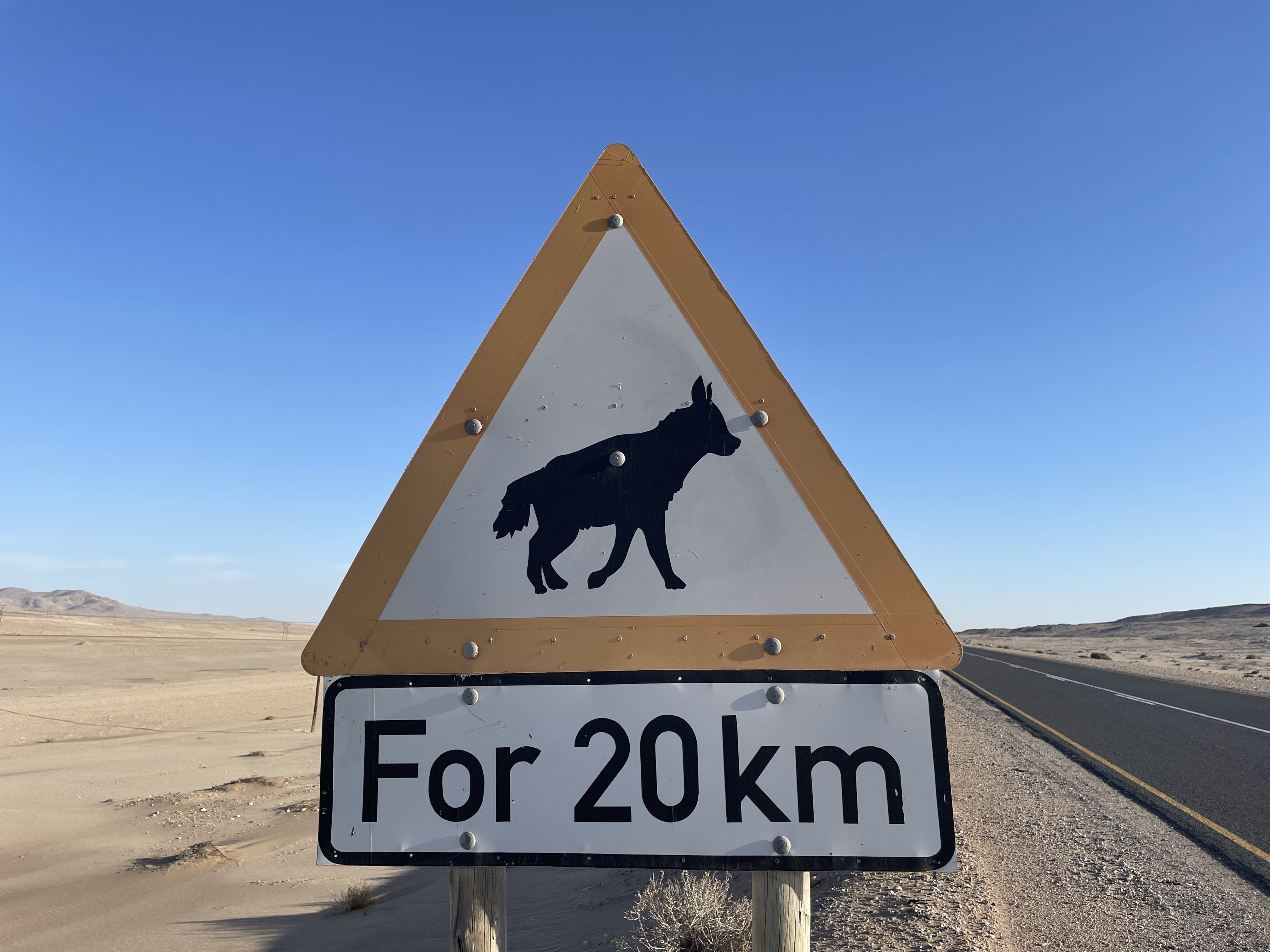
When we finally hit the road, it was almost noon. Of the 400 kilometers we needed to cover that day, most were unpaved. As night began to fall around 6 p.m., we still had about a hundred kilometers to go. I remembered the warning from the 4×4 rental agent a few days ago, advising me not to drive at night. The risk of accidents, especially collisions with wildlife, is much higher since many animals become active at dusk. I gripped the steering wheel tightly and gradually reduced our speed as darkness set in. 80 km/h, then 60, and when it was fully dark, we were down to just 40 kilometers per hour. Soon, we saw the first glints of animal eyes reflecting in our headlights. An oryx slowly crossed the road. A little while later, a herd of springboks appeared, frozen in the middle of the road, blinded by the lights. I brought the car to a complete stop.
Anna and Arthur were delighted, leaning forward and marveling at the animals we were spotting during this unexpected nighttime safari. A desert fox, a kudu, two ostriches, and after a while, even an entire group of zebras. Their black and white stripes glowed in the dark. It was late in the evening by the time we finally arrived at our campsite, but the journey had given us a magical and unexpected wildlife experience under the Namibian night sky.
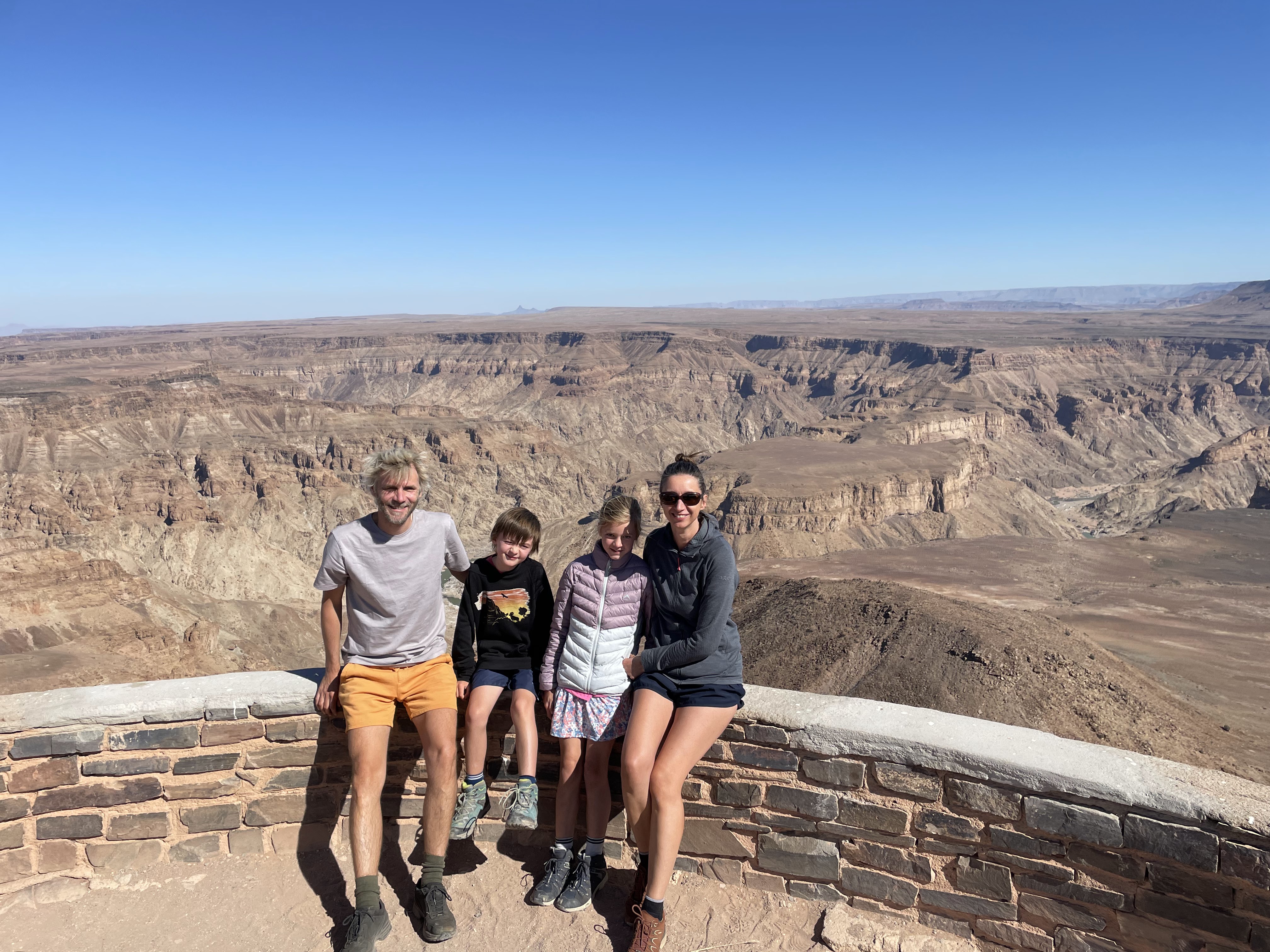
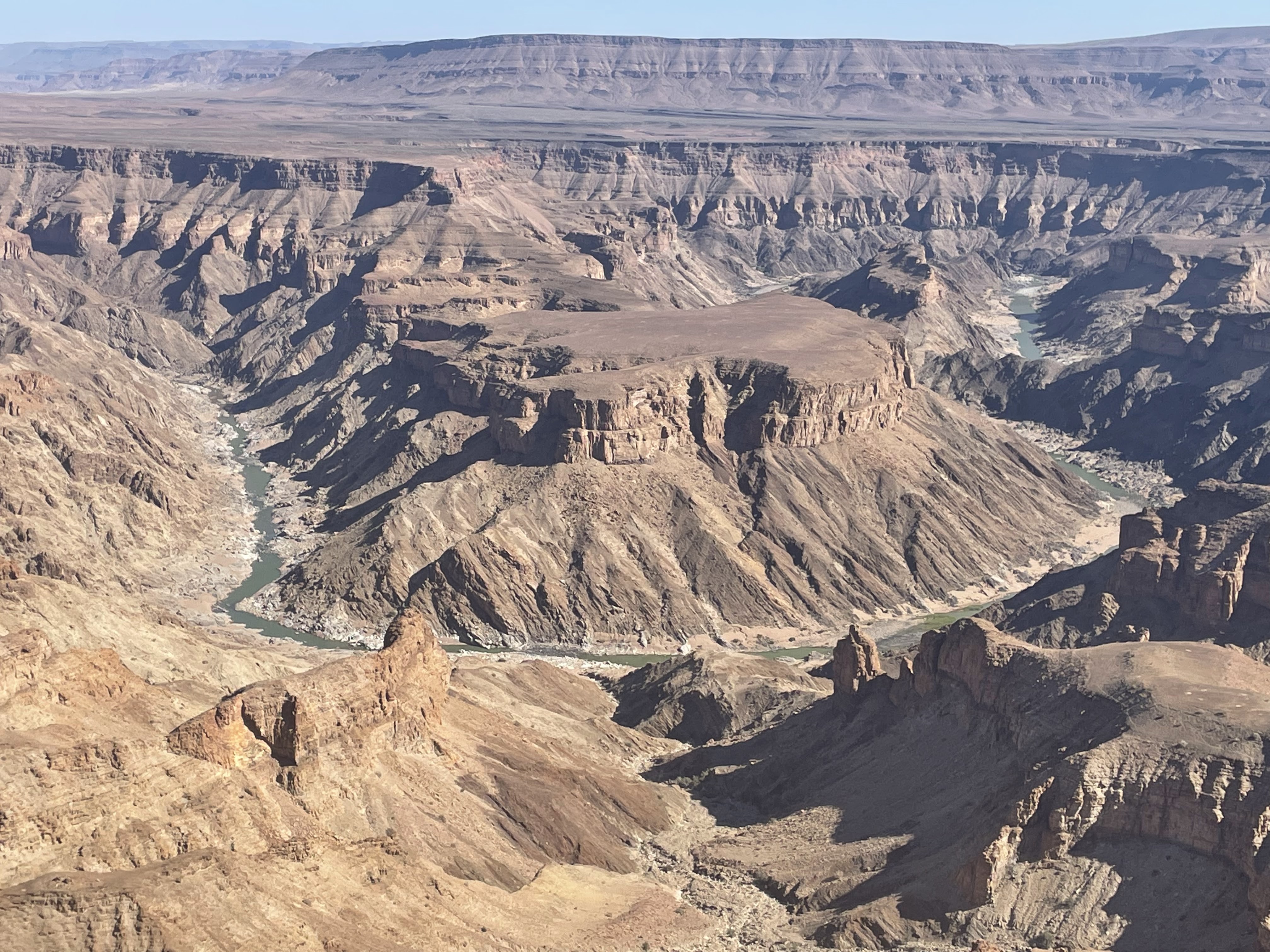
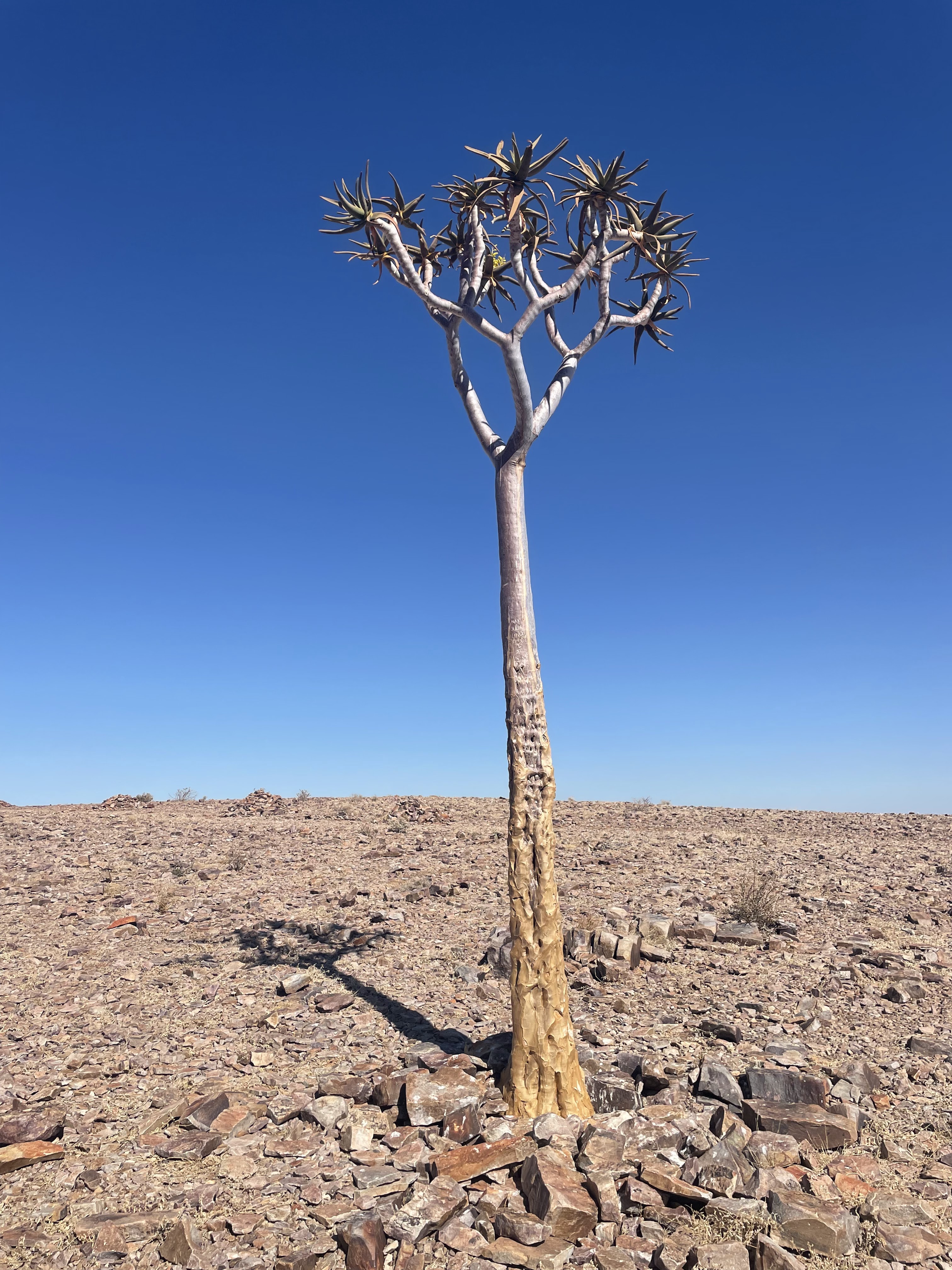

Fish River Canyon reminded us a lot of the Grand Canyon and Canyonlands National Park, which we visited during our trip to America. Standing at the edge, we looked 700 meters down into its depths. The rocky landscape was very different from what we’d seen so far—almost like a lunar landscape. Here and there, we spotted quiver trees, the African cousin of the Joshua trees in North America.
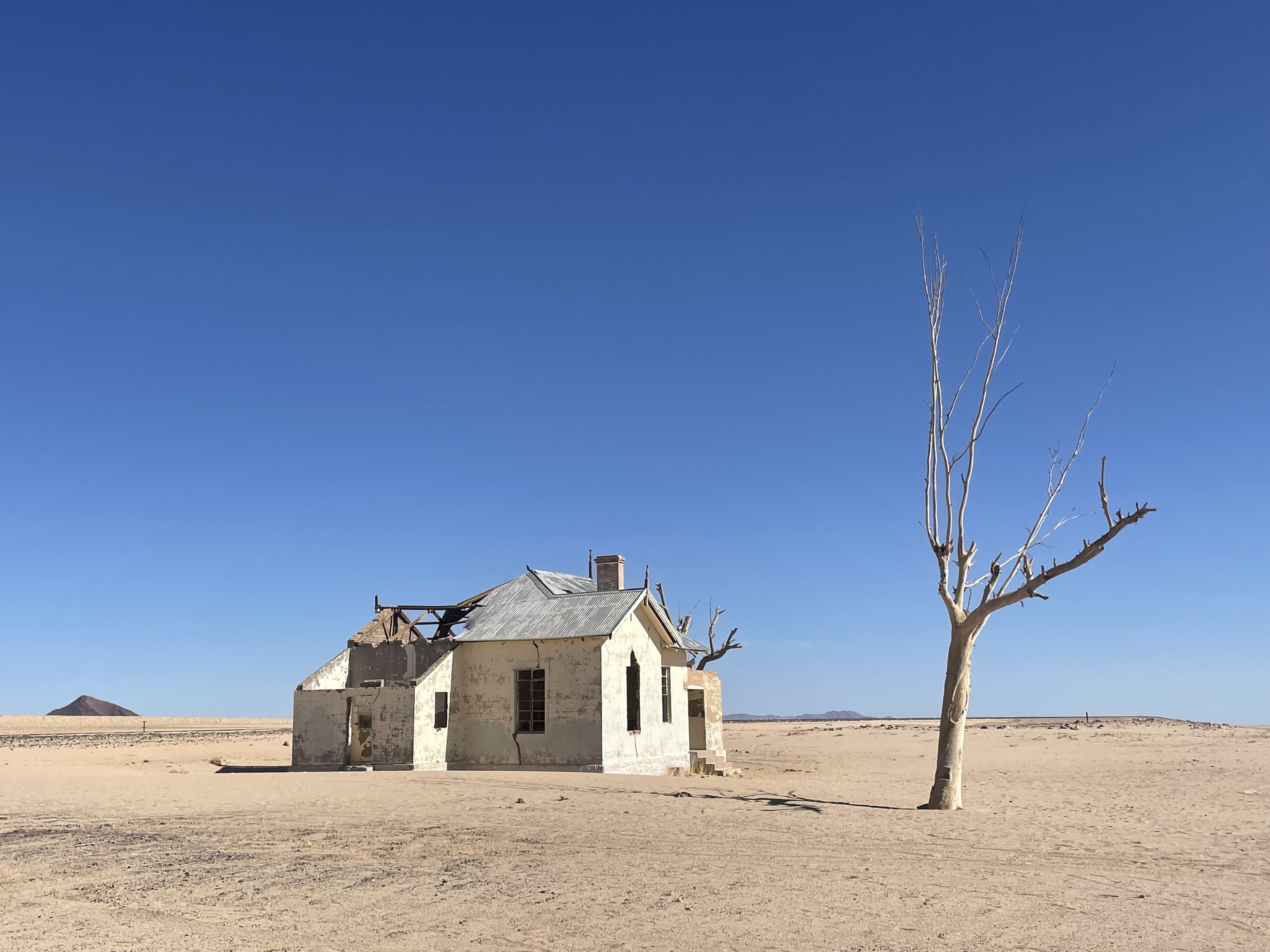
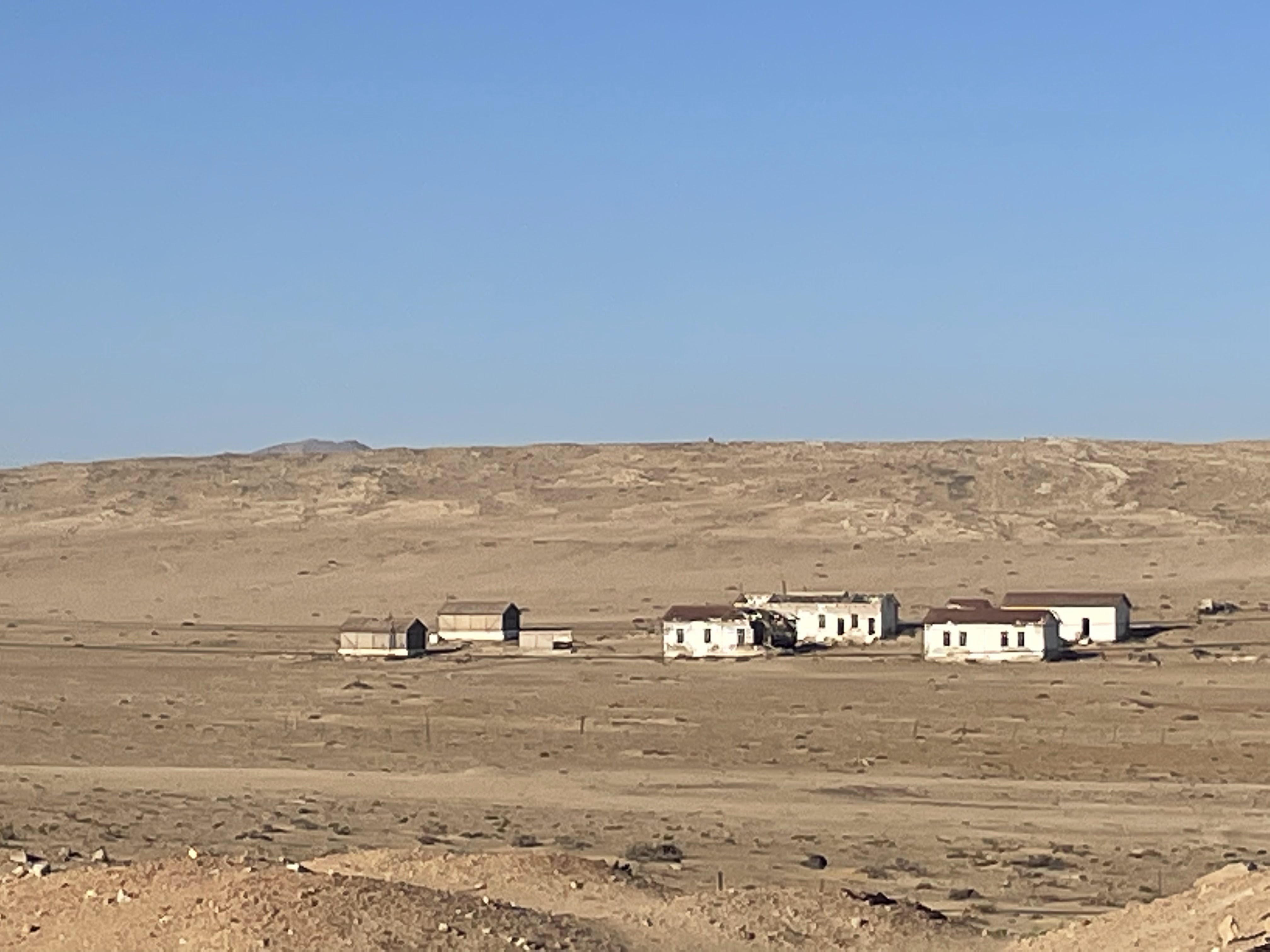
Further west, we arrived in Aus. From there, a straight road cuts across the Naukluft-Namib desert, the oldest desert in the world, all the way to the South Atlantic Ocean. The road ends in the coastal town of Luderitz, where you can see influences from German, Portuguese, and even Dutch settlers (as early as the 18th century, pioneers from the Cape of Good Hope ventured into this region). Not far from Luderitz, we passed the ghost town of Kolmanskop. Diamond and uranium mines have been, and still are, the most important economic drivers in Namibia. Kolmanskop was once a bustling diamond mining town, where precious stones were traded everywhere. But as the diamond reserves dwindled, all that was left was a deserted, ghostly town in the middle of the desert. Collapsed houses, unused railway lines—remnants of a once-thriving hub now overtaken by sand and silence.


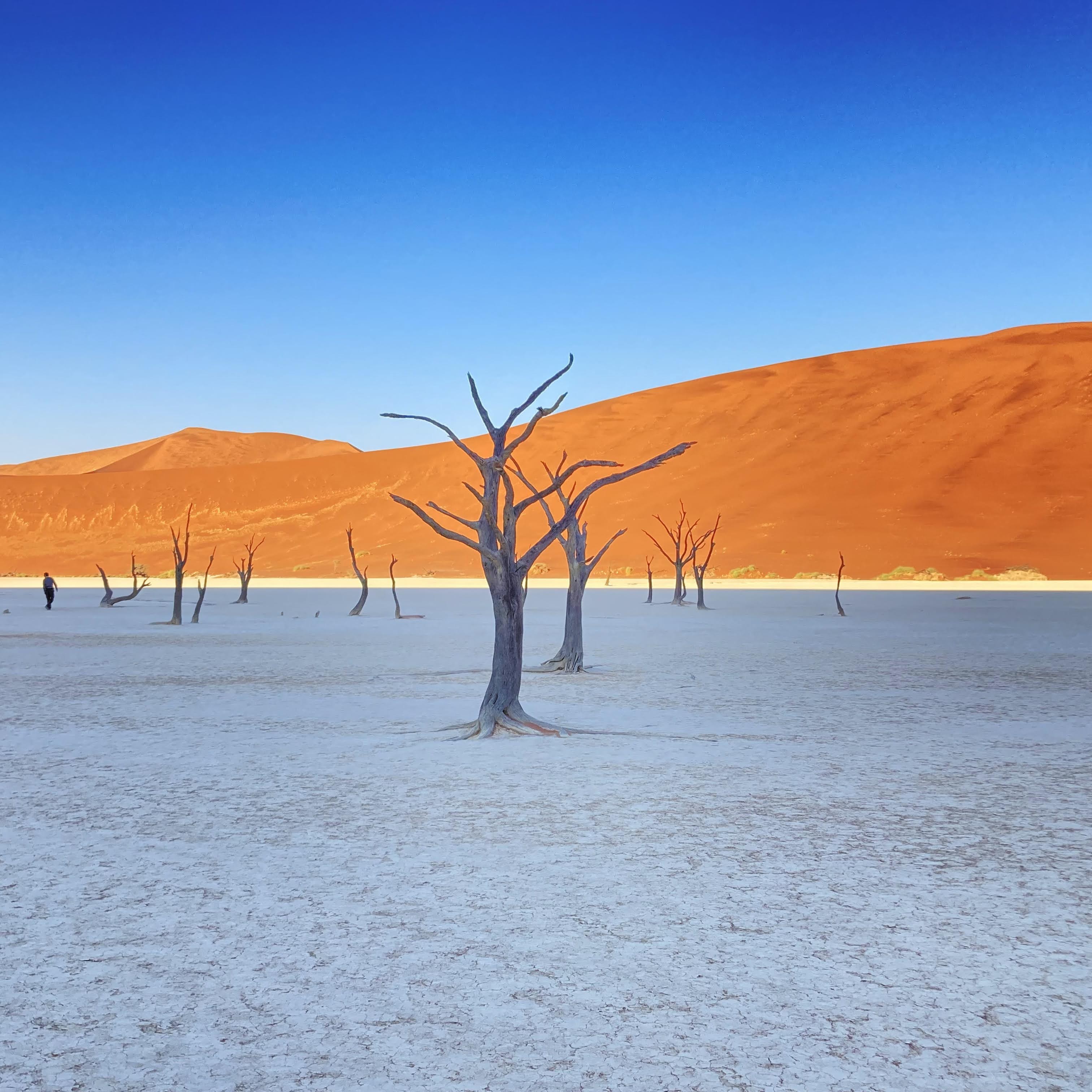
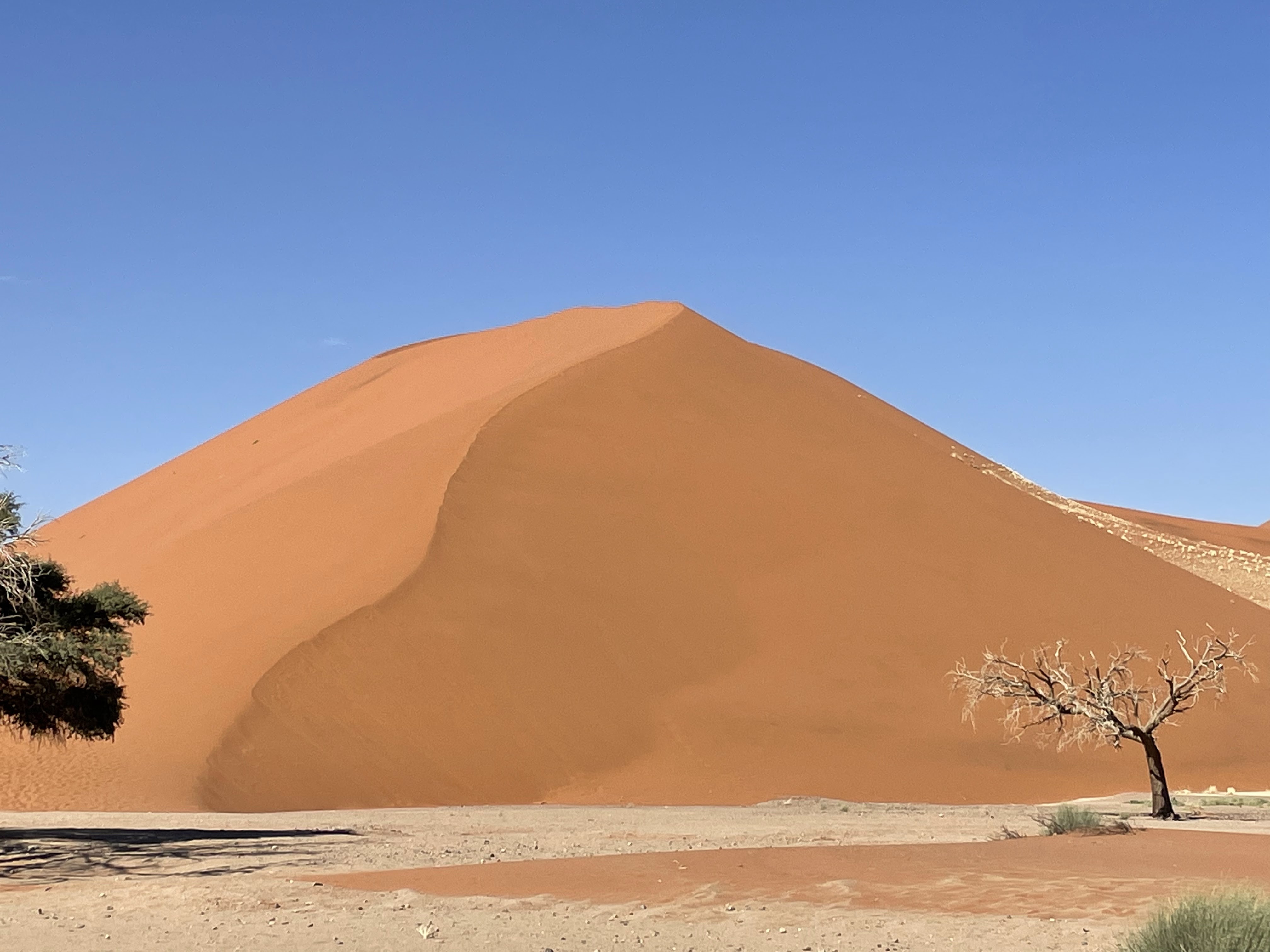
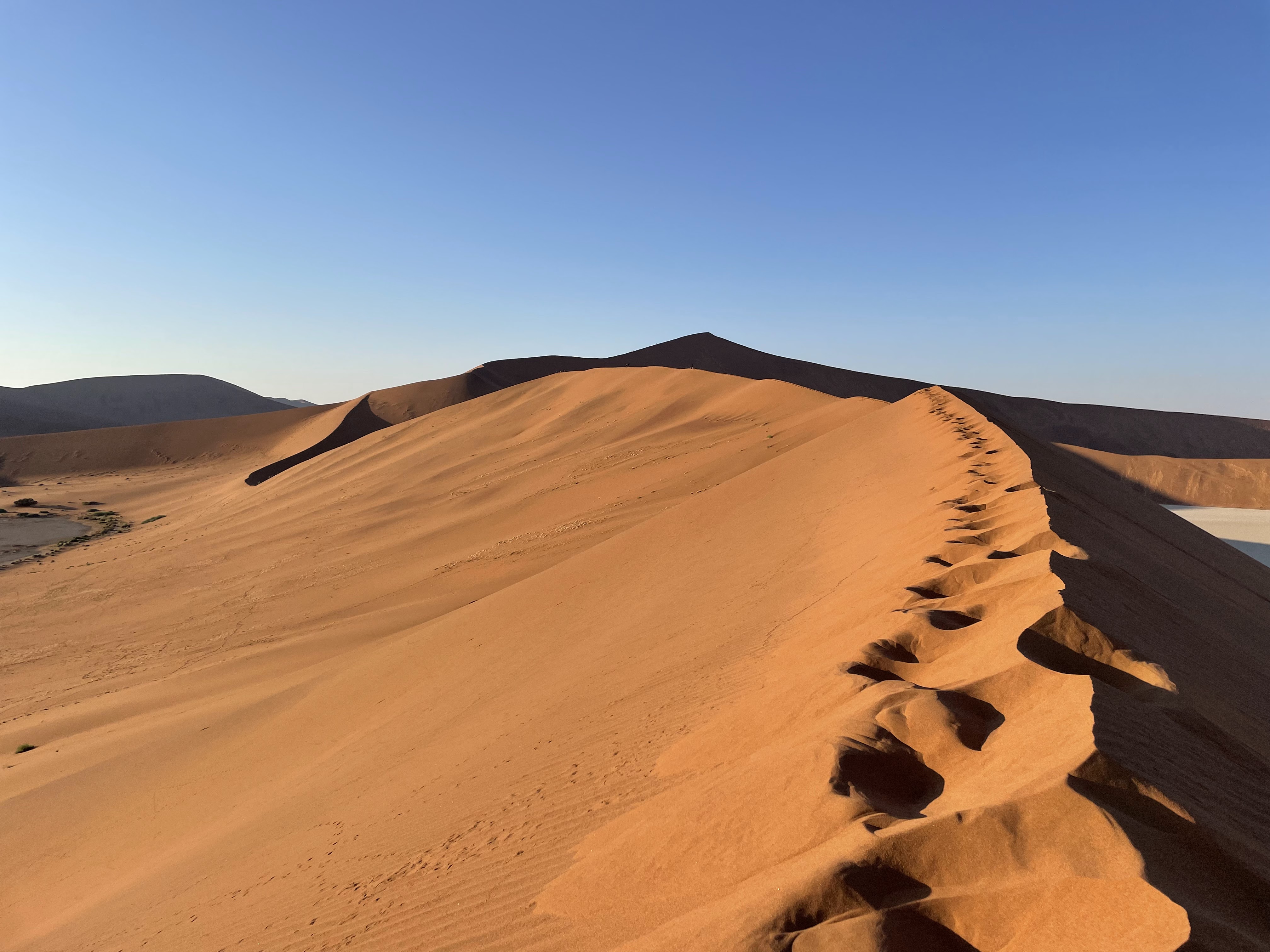
The most special place of our first week came a few days later when we headed north from Aus toward Sossusvlei. White clay pans (vleis) in the middle of the desert create a stark contrast with the ochre-red sand dunes and the vivid blue sky. We woke up early and climbed the dunes at dawn. Our footsteps formed a messy trail along the crest of the dune.
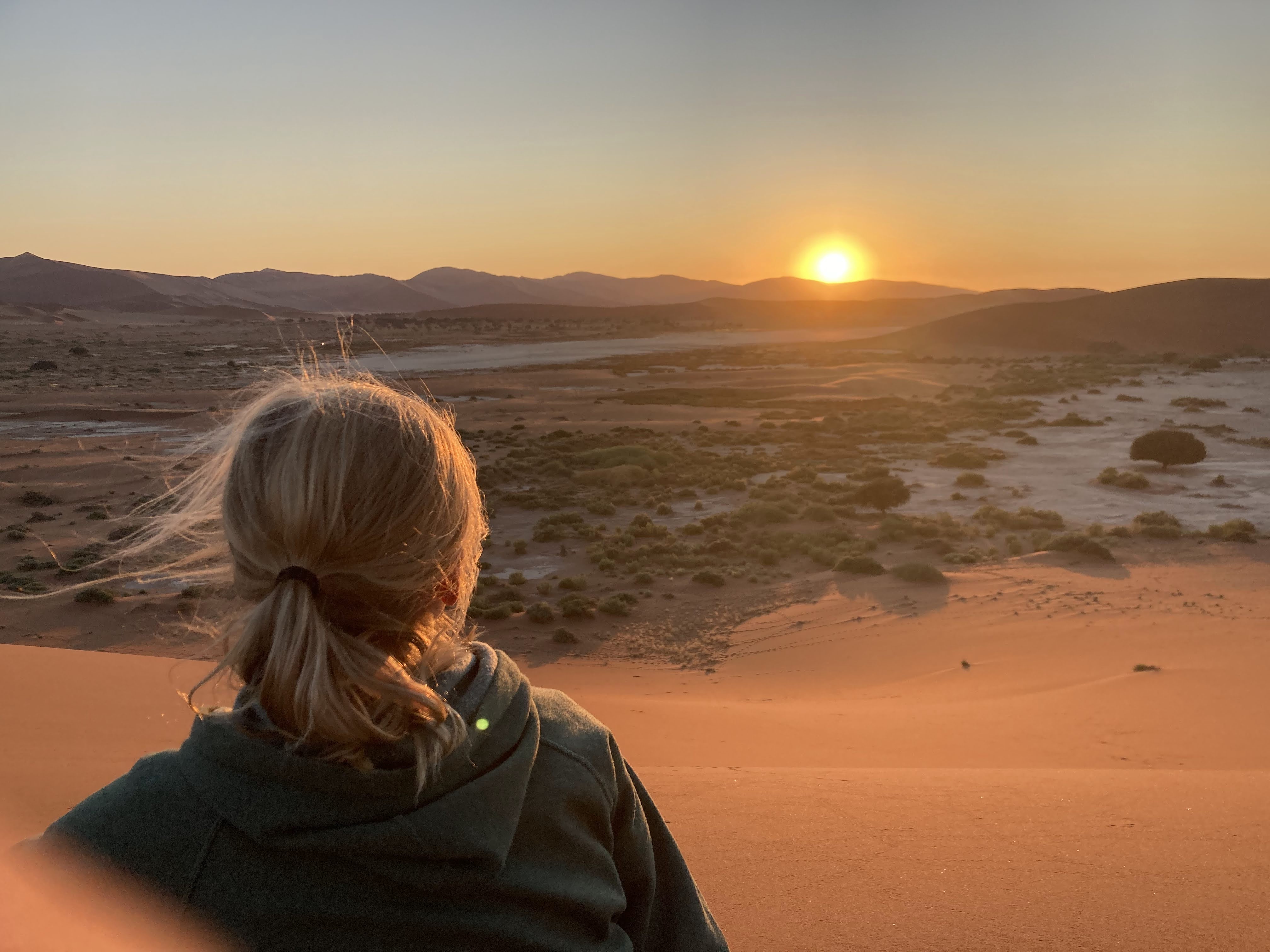
Anna and Arthur were mesmerized by the sight of the red-orange sun rising over the dunes. They sat in the sand, bundled up tightly in their coats, watching as the landscape slowly came to life. It’s almost winter in Namibia, and the nights are chilly. The cold air, the silence, and the gradual glow of the sun turning the dunes a deep, warm red made for a magical and unforgettable moment.


At the end of our first week, we arrived at a community-run campsite at Spitzkoppe. It’s managed by families from the nearby village, providing much-needed income in a region where livelihoods are scarce. We stopped by the village, bought a few souvenirs from the small stand run by two mothers who had been standing in the sun all day, waiting for tourists. We asked if they had children and if they went to school, then handed each of them a bottle of water. As we were leaving, one of the women gave us a traditional African greeting, with a high-pitched call and a dance beside our car. It was a heartfelt gesture that made us feel truly welcome.
Here we were, gazing up at the endless sky, full of stars, with a yellow moon hanging low. Remembering everything. Despite the fatigue and all the setbacks we had faced, we felt an overwhelming sense of happiness.
We climbed the steps to our tent, lay down, and took one last look at the millions of stars and the moonlit mountains before closing the tent. Slowly, we drifted off to sleep, lulled by the peacefulness of the Namibian night.
 Globetrotterdammers