

We are in Kampot, a charming and laid-back town in southeastern Cambodia, near the border with Vietnam. It sits by the river, with wide roads leading to large, empty squares. The sleepy, grid-like downtown is known as the French Quarter, filled with old colonial architecture. Rows of colorful, beautifully designed shops are slowly crumbling. You’ll find cluttered stores, restaurants, bars, laundries, and guesthouses. Cambodians nap in hammocks under the verandas. On the sidewalks, carts sell all sorts of local dishes. In the streets, tuk-tuks, scooters, and cyclists pass by slowly. No one is in a hurry here.
Our Lonely Planet described it perfectly: this town has a dreamy feel, as if someone hit the “pause” button years ago, and the whole place forgot to wake up. It’s true.


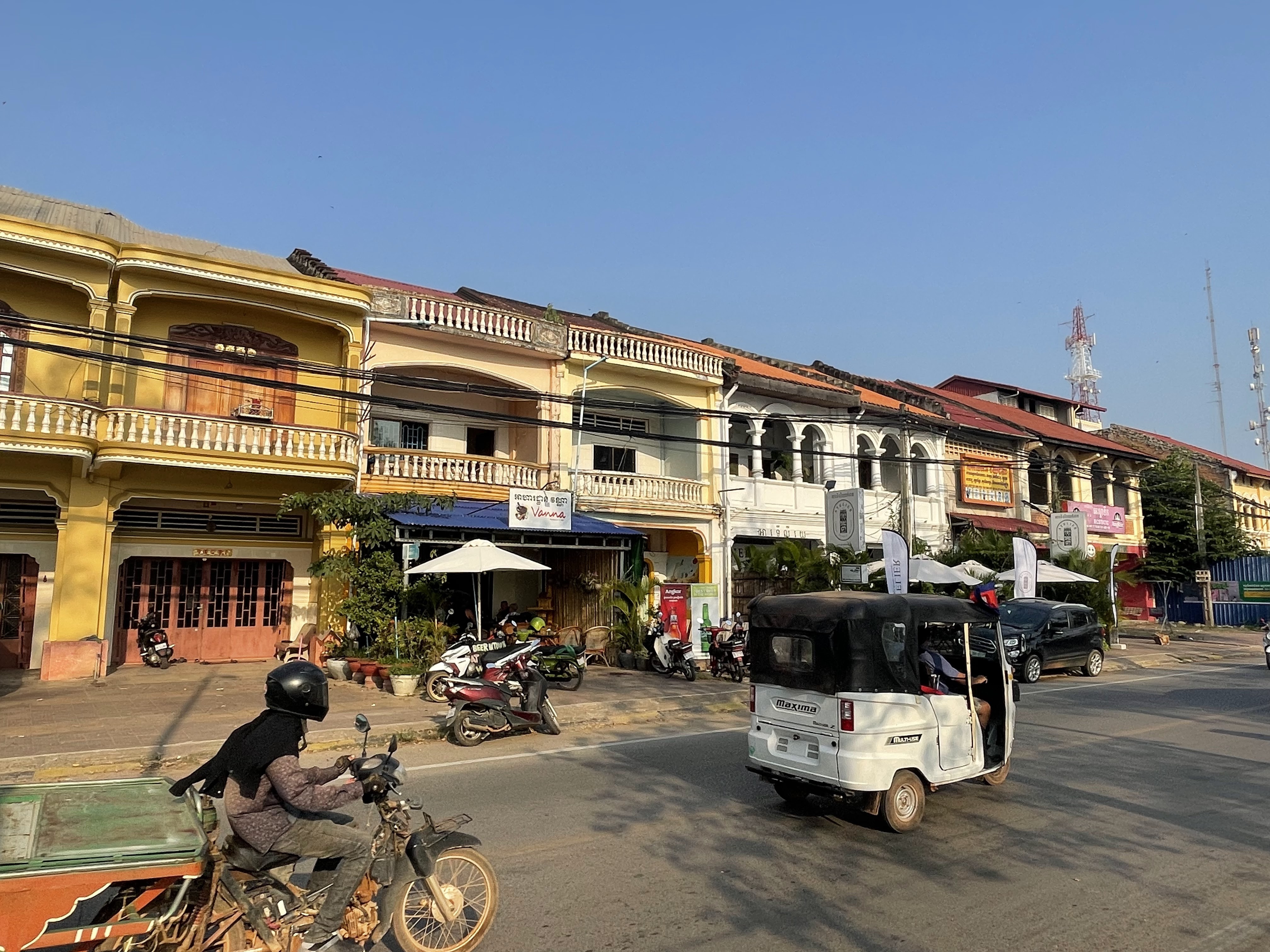


The wind plays with our hair, and despite the early hour, we can already feel the warm air gliding over our faces. It’s 9 a.m., and we’re sitting in a tuk-tuk we’ve rented to explore the countryside around Kampot. This tuk-tuk, also known as a “remork” (from the French word “remorque”), is essentially a moped with a trailer attached. Quite comfortable.
After half an hour, we leave the main road and turn onto an unpaved path. Rice fields, huts on wooden stilts, the occasional cow crossing the road, and barking dogs. From their hammocks, the locals watch us pass by. Most of the children are at school. The road is rough, and we bounce on our seats from all the potholes and bumps. Clouds of dust settle over us, and our masks prove to be very useful. We’re headed to La Plantation, one of the pepper plantations for which this region is famous. After a few kilometers, our driver stops at the edge of a large lake, precisely where a dam was built. The opening of the dam supplies water to a vast area, on which the plantations and rice farmers depend.
When Marie-Laure asks where we are, he begins to tell us about the tragedy that unfolded here around 45 years ago. This area was a major refuge for Cambodians who were driven out of the cities by the Khmer Rouge regime, which sought to turn Cambodia into a self-sufficient agricultural state between 1975 and 1979. Millions of Cambodians lived in miserable conditions in the countryside, with insufficient food, and people starved. Since everything was kept secret during the regime, this lake was as well. The regime wanted to build a dam and forced thousands of starving people to work on it. Many did not survive. In the middle of the lake, the remnants of the village, submerged by the water, still stand just above the surface. The lake became known as Secret Lake.
His English isn’t very good, but we understand exactly what he means. Emotion seeps into his voice. He was born in the early 1980s, but his parents lived through it all and often spoke to him about it. A dark chapter in the country’s history. More than one and a half million Cambodians, most of them well-educated and influential, were killed. A bizarre detail: people stopped wearing glasses because it was seen as a sign of intelligence and could lead to arrest. The consequences of that period are still felt in the country’s development, even after all this time. It’s no surprise that Cambodia remains one of the poorest countries in the world. People have been trying to move on for a long time, but wherever you go, the past always finds its way back.


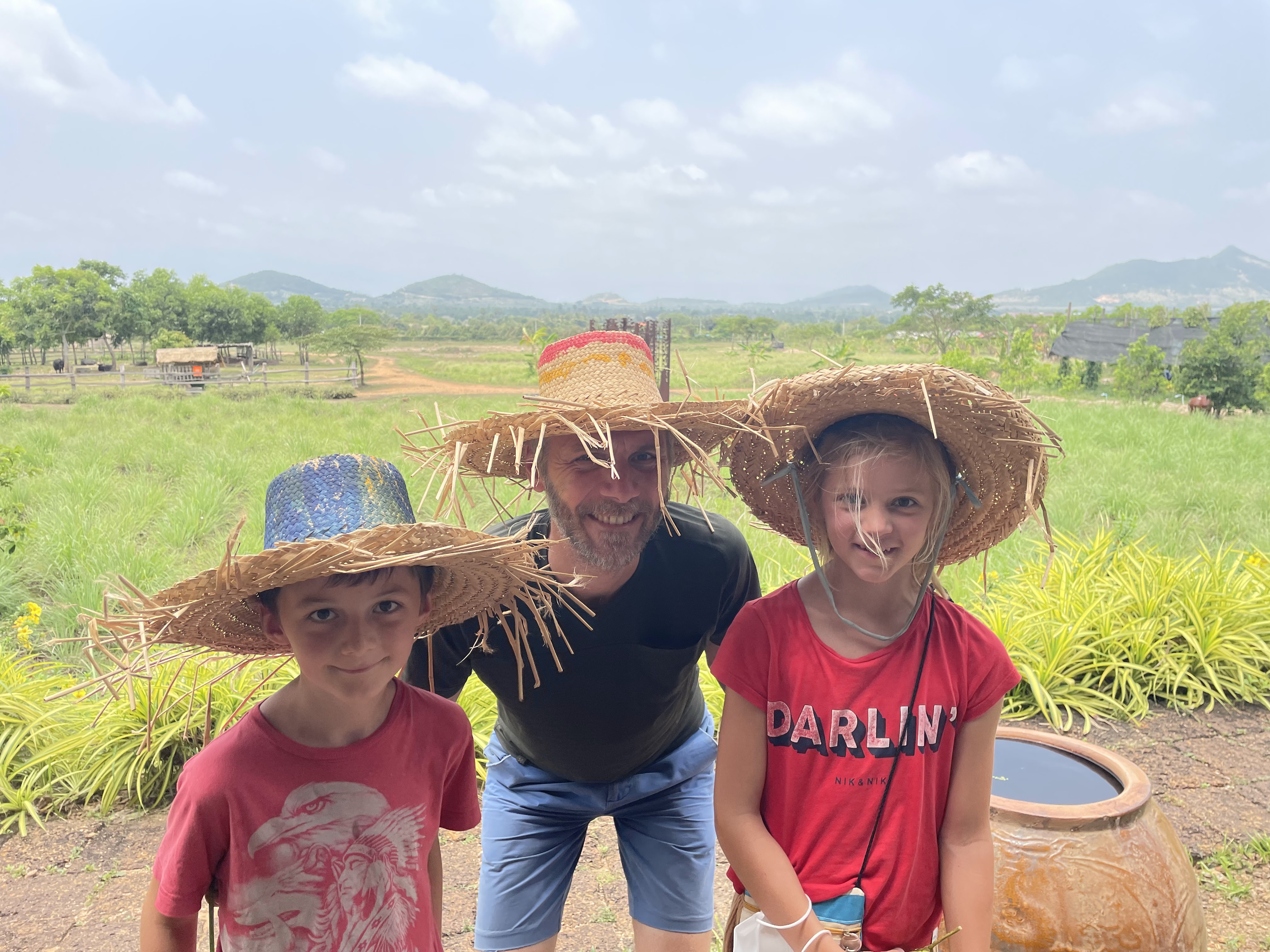

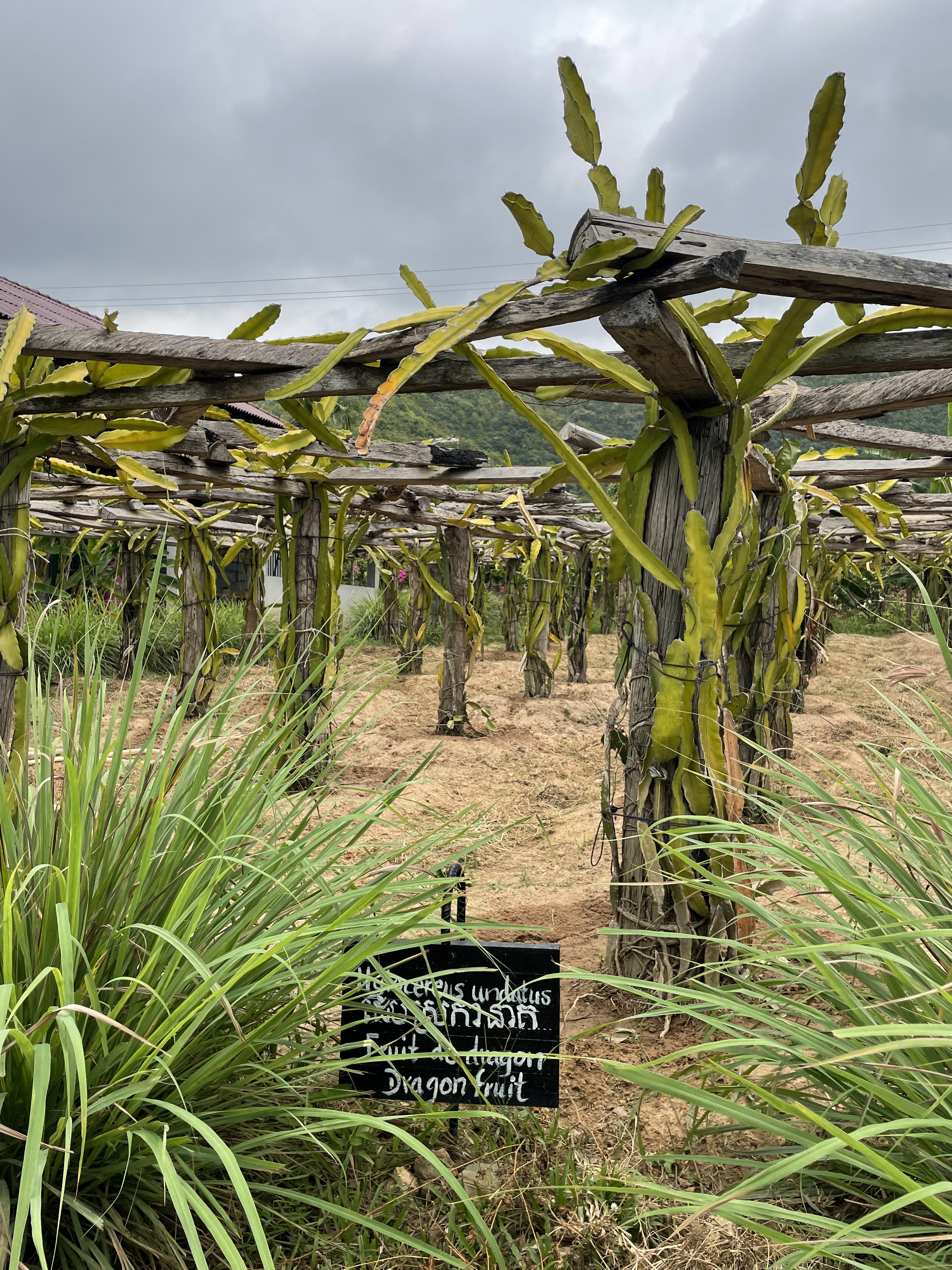
The pepper farm is located on the edge of Secret Lake and was established in 2013 by Guy and Nathalie, a Franco-Belgian couple who moved to Kampot and turned it into a social project. The plantation provides jobs, organizes guided tours and cooking workshops, and has an educational program that helps children from neighboring villages stay in school longer. We take a tour of the plantation and see how pepper is cultivated. Anna and Arthur learn about the different types of pepper. Kampot pepper is recognized worldwide for its exceptional quality and was one of the first products outside Europe to receive AOC certification. The tour ends with a tasting session. We try black, green, red, and white pepper, smoked pepper, fresh cardamom, and various pepper-based spice blends that are remarkably mild and flavorful. Arthur, who usually complains at home whenever he finds even a single peppercorn in his spaghetti carbonara, enthusiastically participates in the tasting. “This is delicious. I’ll give this one a three, and that one a two!” he declares. Then the kids get to choose which peppers to buy, quickly filling our little wicker basket. We leave the tasting with a bag full of different types of pepper. La Plantation, located on the shores of Secret Lake, is a wonderful place to visit.
After lunch, we head to Kep, the last village before the Vietnamese border. Kep is a peculiar place. There’s a beach, a noisy fish market where the local specialty, sea crab, is bargained over, and a large white statue of a sort of mermaid with a generous bust on a jetty near the beach. Along the road, stalls sell food, and Cambodians try to rent out deck chairs and hammocks. Behind them, a jungle sprawls over the hills.
On the beach, it feels like any other seaside town in Asia. But once you stray from the boulevard, you begin to understand why this place is so strange. You see streets and alleys lined with deserted, half-collapsed villas. It’s a true ghost town behind the boulevard. Gray concrete skeletons, once designed by architects, now lie in ruins, abandoned for decades. Wide avenues overgrown with vegetation, garden walls being overtaken by trees, elegant wrought iron gates hanging askew. New houses or huts have often been built on the street side, but only a small portion of the original homes have been renovated.
Our driver tells us the story. Kep was once Cambodia’s most popular seaside resort. In the 1950s, it was known as the “St. Tropez of Southeast Asia.” Many Europeans, especially the French, had built their villas there, and the town had the feel of a Mediterranean city. A boulevard, white beaches, hills, and plenty of wealth. But in the 1960s, under Lon Nol’s rule, Cambodia was almost inevitably drawn into the conflict with neighboring Vietnam. The Americans bombed Kep first, followed by the Vietnamese. The French left the town, never to return. In the 1970s, when the population was starving, the country homes were stripped by locals of anything that could be sold across the border in Vietnam in exchange for food. Another bizarre detail: Pol Pot’s regime had decided to abolish money. Currency as a means of exchange no longer existed. The absurdity of this situation is beyond comprehension.
Forty years later, it all feels like it happened yesterday. Nothing has been cleaned up. It’s a typical example of how Cambodia is still grappling with its past.
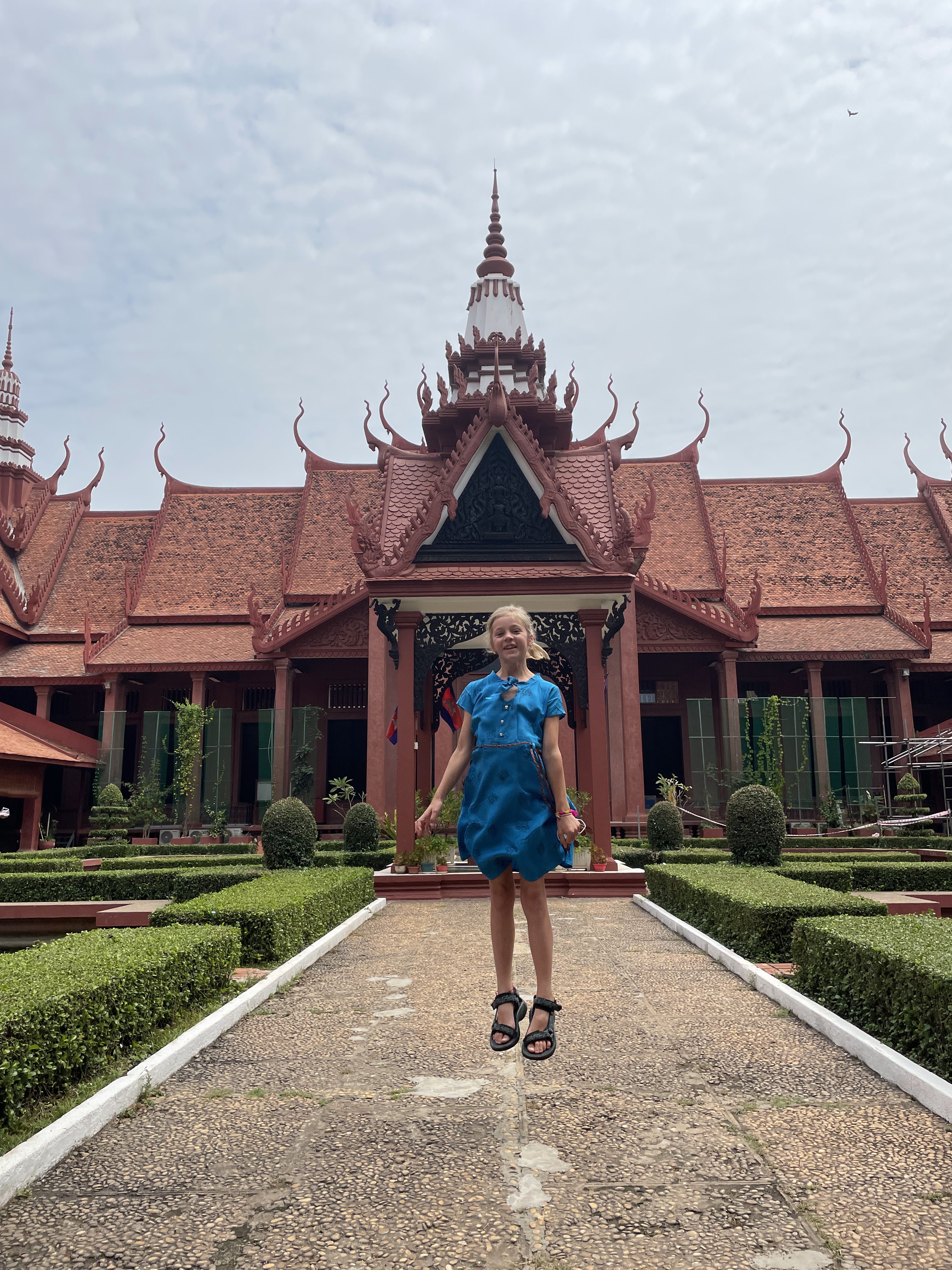
What a contrast with what we saw in Phnom Penh at the beginning of our journey in Cambodia. Phnom Penh has always been the pearl of Asia, at the heart of the Khmer Empire, situated on the Mekong with grand boulevards, squares, parks, and beautiful Khmer architecture. The city is developing rapidly. An old historic center full of French influences, with the magnificent Royal Palace and National Museum set against the backdrop of modern skyscrapers. High-end hotel chains, gourmet restaurants, and luxury boutiques. The investments made since the turn of the century, particularly by the Chinese who are trying to expand their influence here, have certainly hit their mark. Phnom Penh looks like a metropolis, even though it’s a relatively small city with just 2 million inhabitants. This city, too, has suffered from Pol Pot’s brutal policies. The Tuol Sleng Genocide Museum and the killing fields of Choeung Ek are living witnesses to the atrocities committed. If you want to understand this country, you have to see them. We definitely will, but since the museum is not suitable for children, we have postponed our visit for now. Perhaps at the end of our journey through Cambodia.
At the end of our first week in this country, we’ve realized that the present and the past coexist here. You can’t understand the present without knowing the past. What we see around us is only half the story. Beneath it lies something much deeper.

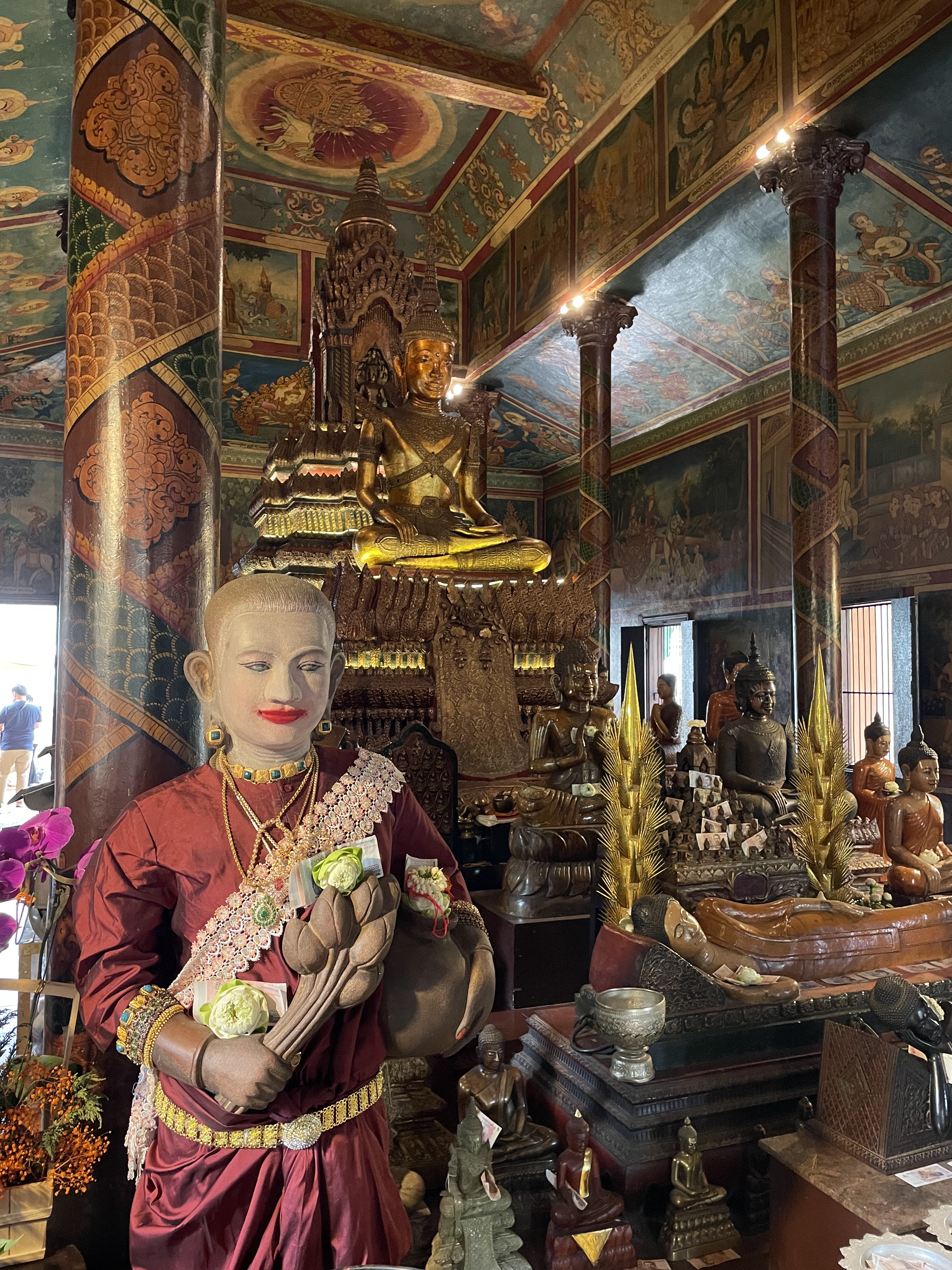

Tonight, we’re dining in the old town of Kampot. We’re in luck because this city is a true culinary paradise. There are many small, affordable restaurants offering a fusion of traditional European dishes and traditional Cambodian cuisine. We order fish Amok, beef Lok Lak, and green curry, savoring the richness of the flavors. How delicious!
On our way back, we pass by a beautiful old hotel painted yellow. On the facade, it reads “La Java Bleue.” Typical. “La Java Bleue” was a mid-century musette-style song, danced to in Parisian bistros and at balls. Marie-Laure pulls up YouTube, and we dance our way back to the hotel through the empty streets, singing:
C’est la java bleue
La java la plus belle
Celle qui ensorcelle
Quand on la danse les yeux dans les yeux
Un rythme joyeux
Quand les cadavres se confondent
Comme elle au monde
Il n’y a que deux
C’est la java bleue
Tomorrow, we’ll pack our bags and board the boat. Something completely different awaits us: destination Koh Rong Samloem. Palm trees, white beaches, and an azure blue sea.
This is also what Cambodia is today.
 Globetrotterdammers