

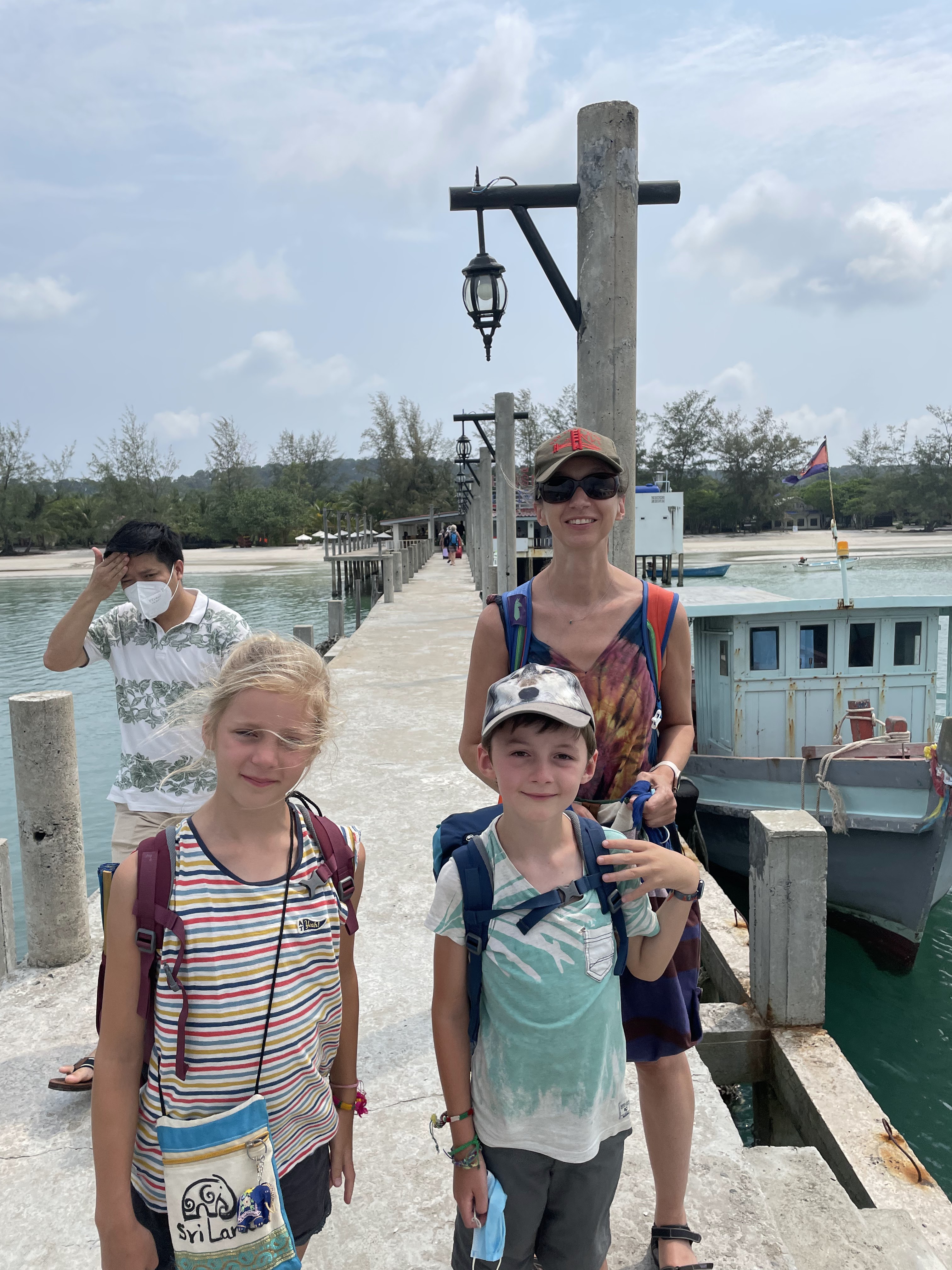
The wooden plank that connects the boat to the jetty is two meters long, barely 30 cm wide, and bends dangerously under the weight of our backpacks. For a moment, I’m afraid it will break, plunging all of us into the depths of the sea. Carefully, one by one, we make it to the jetty. We’ve arrived at Koh Rong Samloem, a small tropical island off the coast of Cambodia. Azure blue sea. White beaches. Palm trees. Hammocks. Paradise!
Six days on a paradise island where there isn’t much to do—a real challenge for us, who have been on the move constantly for almost three months. But everyone feels it’s time to put down our bags and take a little break. It won’t just be about lounging in a hammock, though, because our travel plans for the coming weeks in Cambodia, and especially for the two months in America that will follow, still need to be finalized. But we should have time to do that over the next few days. Along with a handful of other backpackers, we walk along the jetty to the beach. The sun on our skin, our feet in the fine sand, and the delicious smells of food around us. We feel perfectly content.
Koh Rong Samloem, like the slightly larger Koh Rong nearby, seems to be an invitation to laziness. The law of laziness rules here: “Can’t reach it? Don’t need it!” Our hotel, Villa Paradise, is a little further down the beach: “Welcome to Paradise” is written above the entrance.
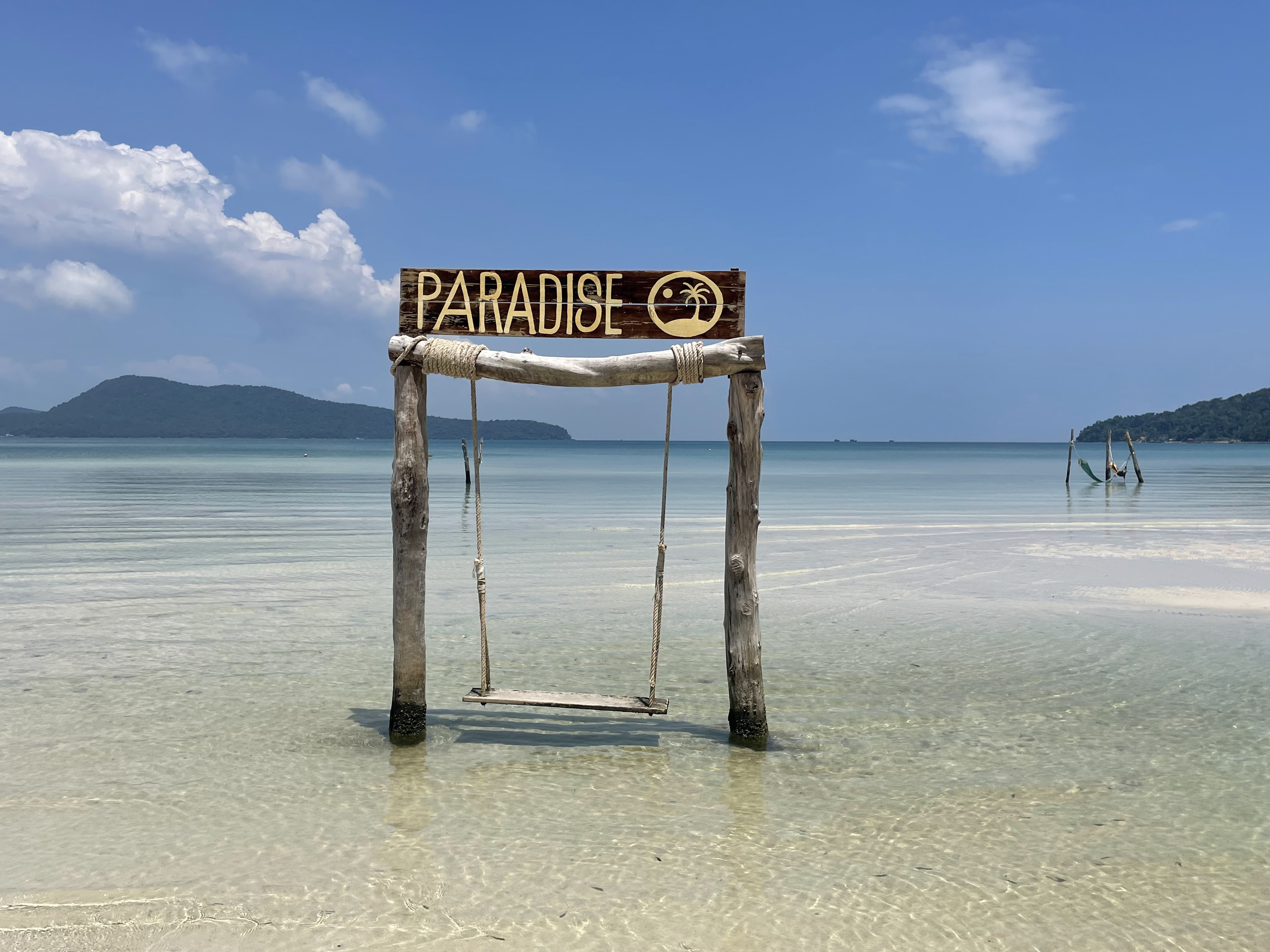


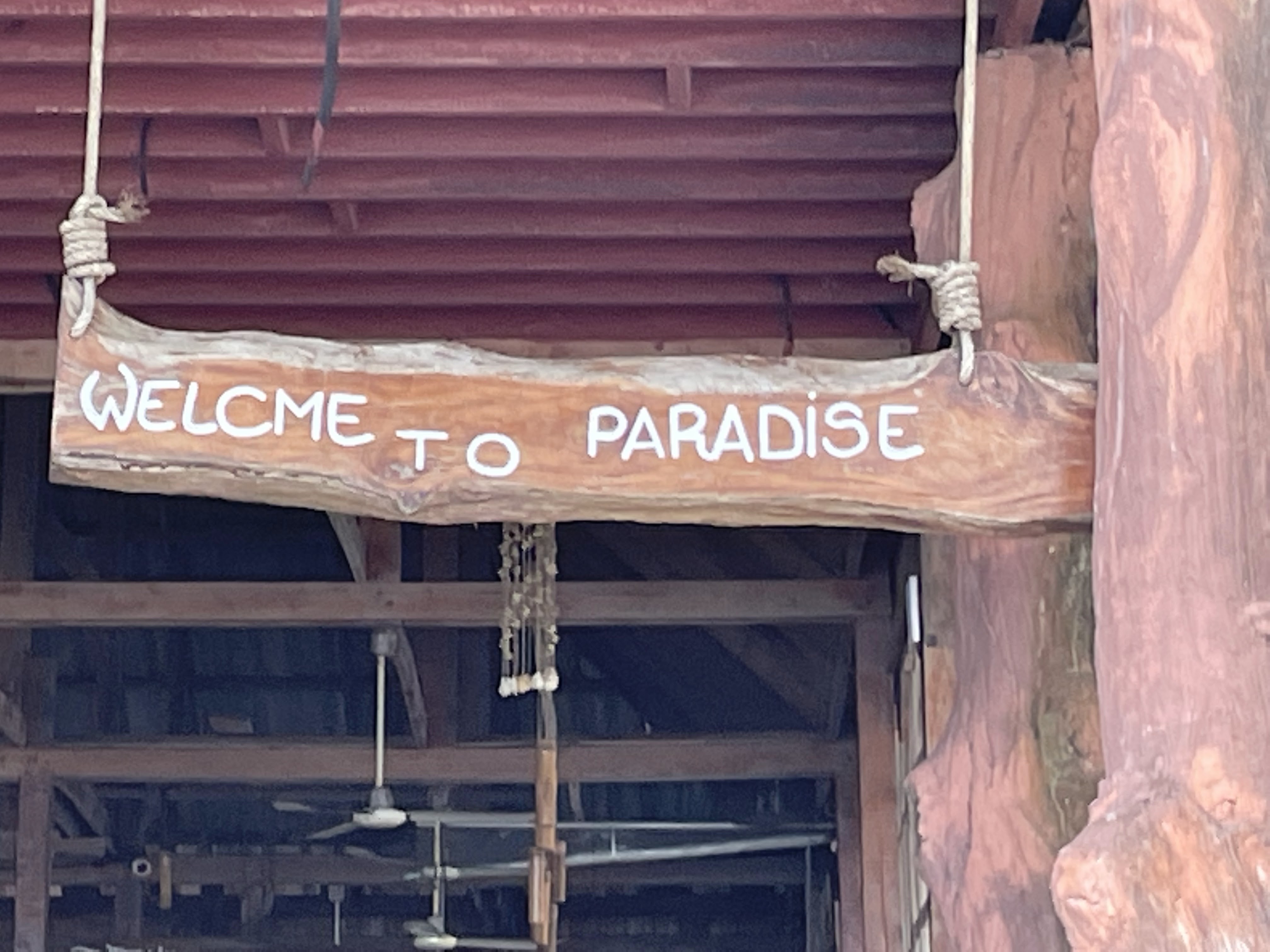
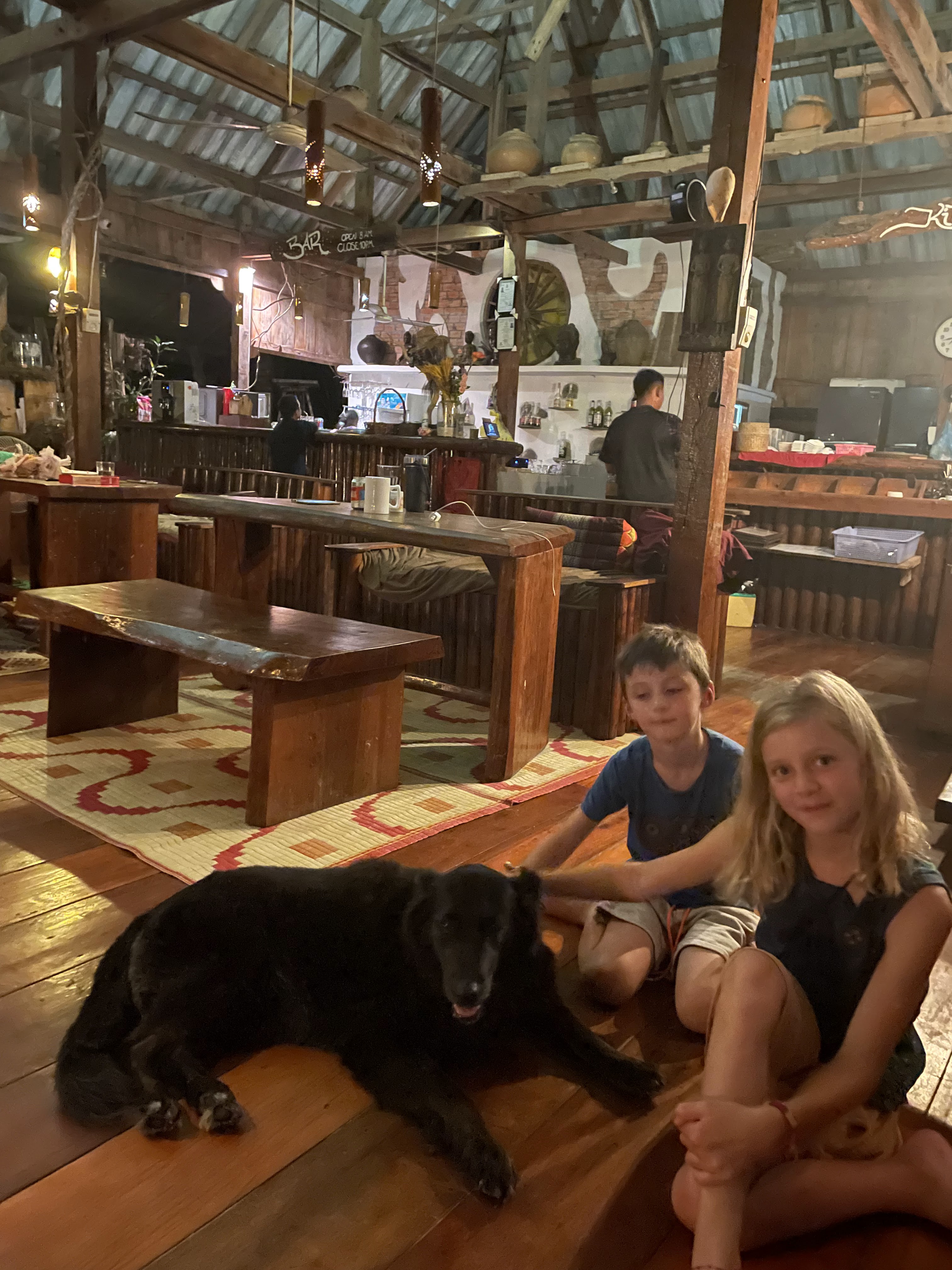

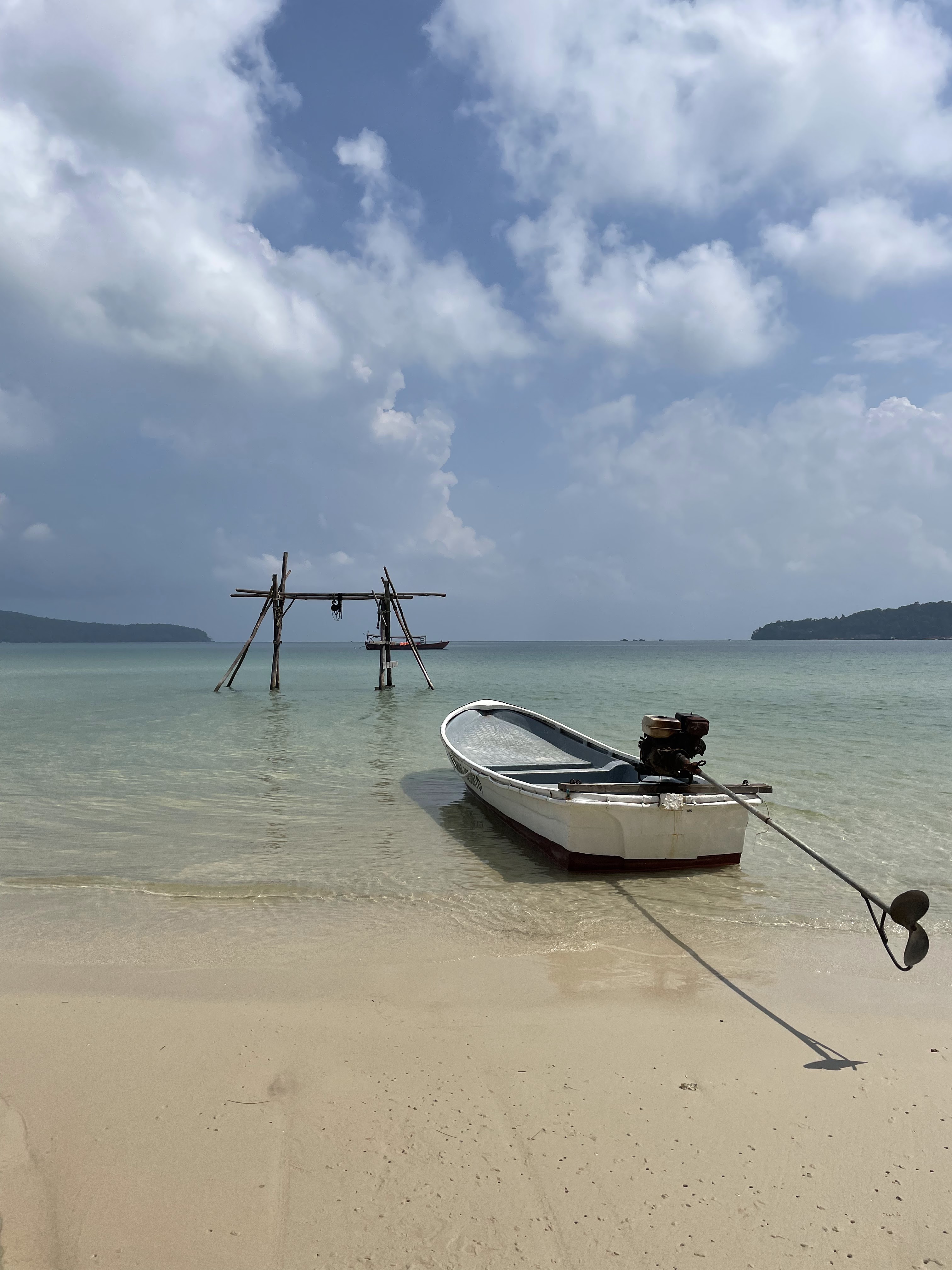
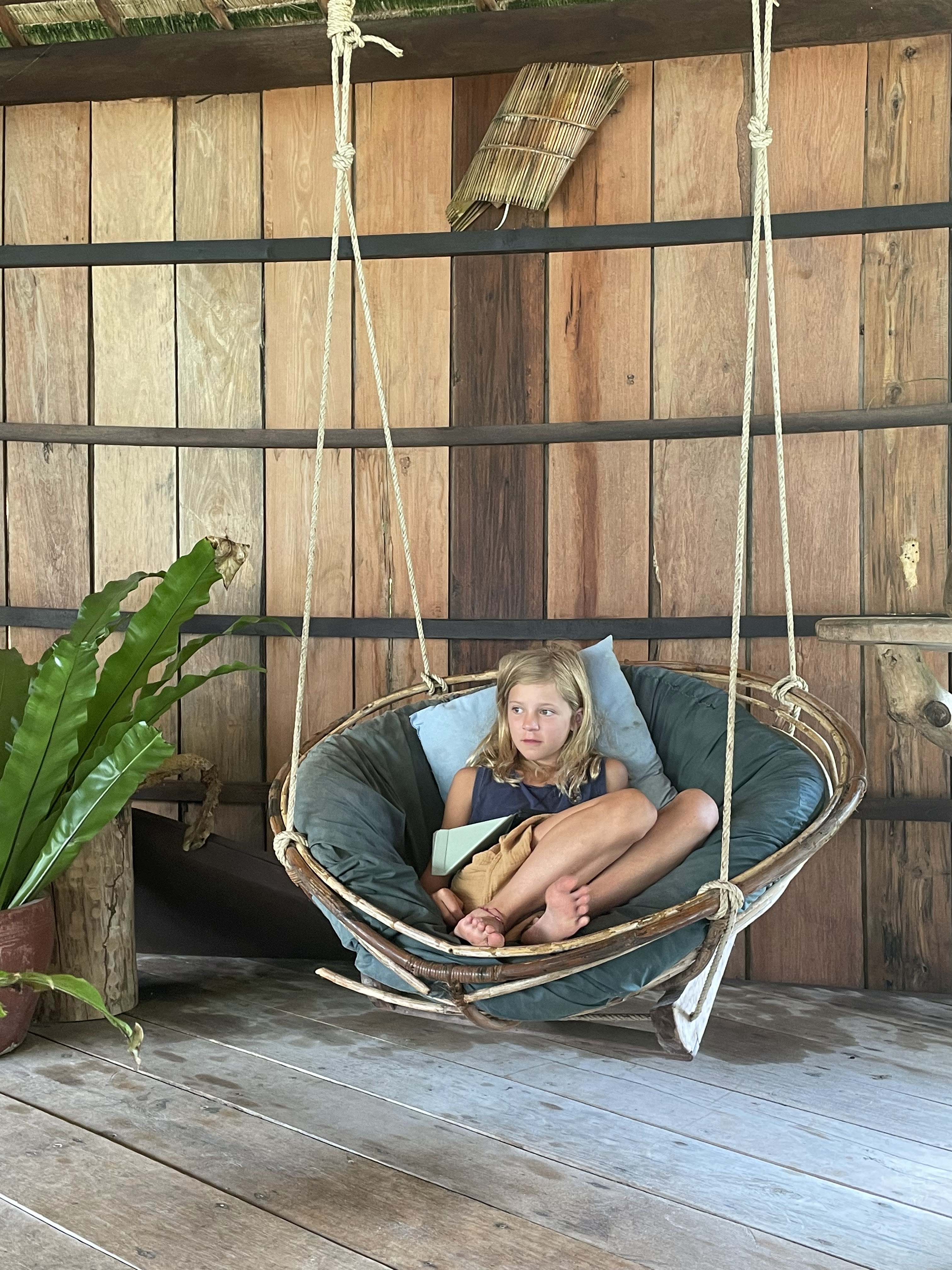
Paradise is a unique place. A few bungalows on the beach and a large Khmer-style wooden building open to the sea, with fans whirring. Meditation mats in the center allow those who want to lie down and rest. Long benches with soft cushions welcome the lazy. We sleep in a small bungalow on the beach under the coconut trees, with a view of the bay. A swing hangs over the waves, a hammock sits under a palm tree, and there are beds with mosquito nets and an outdoor shower under the stars.
We meet the residents. A Cambodian family working in the kitchen all day. A group of young men and women who run Paradise (we quickly learn that most of them are orphans, and Paradise is a social enterprise where these young adults have the opportunity to learn a trade). A Brazilian woman on conference calls with her job every morning and evening, her Italian friend who does nothing but go fetch cigarettes from the ‘supply boat’ once a week, and a German who seems connected to the family running the hotel but never says a word. There’s also a Frenchman who arrived over a year ago and decided to stay. As we chat, we discover that most of the island’s inhabitants, like us, once stepped off the ferry with a backpack and never left. Koh Rong Samloem forever.
The next morning. 7 a.m. Just me, alone on a swing facing the sea. The sun has just risen, and everyone is slowly waking up. It’s already 28 degrees. A few wisps of air make the coconut palms sway. Small waves gently lap at the white sand. A silver sea reflects the sky, the boats, and the jetty where ferries dock three times a day. White sandy beaches, turquoise water at 28 degrees. I rub my eyes in disbelief at this postcard-perfect view.
A little later, Pat Pat and TomTom, the two dogs of Paradise, come over to introduce themselves. They’re already wet and covered in sand. A nudge from a wet nose to say hello, and then they’re off on their adventures. Pat Pat is gentle but stays discreet. Most of the time, we don’t see him, but in the evening, he loves having his belly rubbed as he lies on his back, paws up, dreaming. TomTom is much more sociable, digging a hole in the sand next to the kids to watch the sea for hours. He comes when the kids call him and doesn’t leave their side all week. Anna and Arthur are smitten. “Mom, where’s PatPat?” “Dad, where’s TomTom?” “Tooooommmm Tooooommmmm? Paaaaaatttt Paaaaatttt?” And of course, the crucial question: “When we’re back home, can we get a dog? And can it be just like TomTom?”
As for the dogs, they let us pamper and cuddle them all day, and then suddenly, they’re off again.
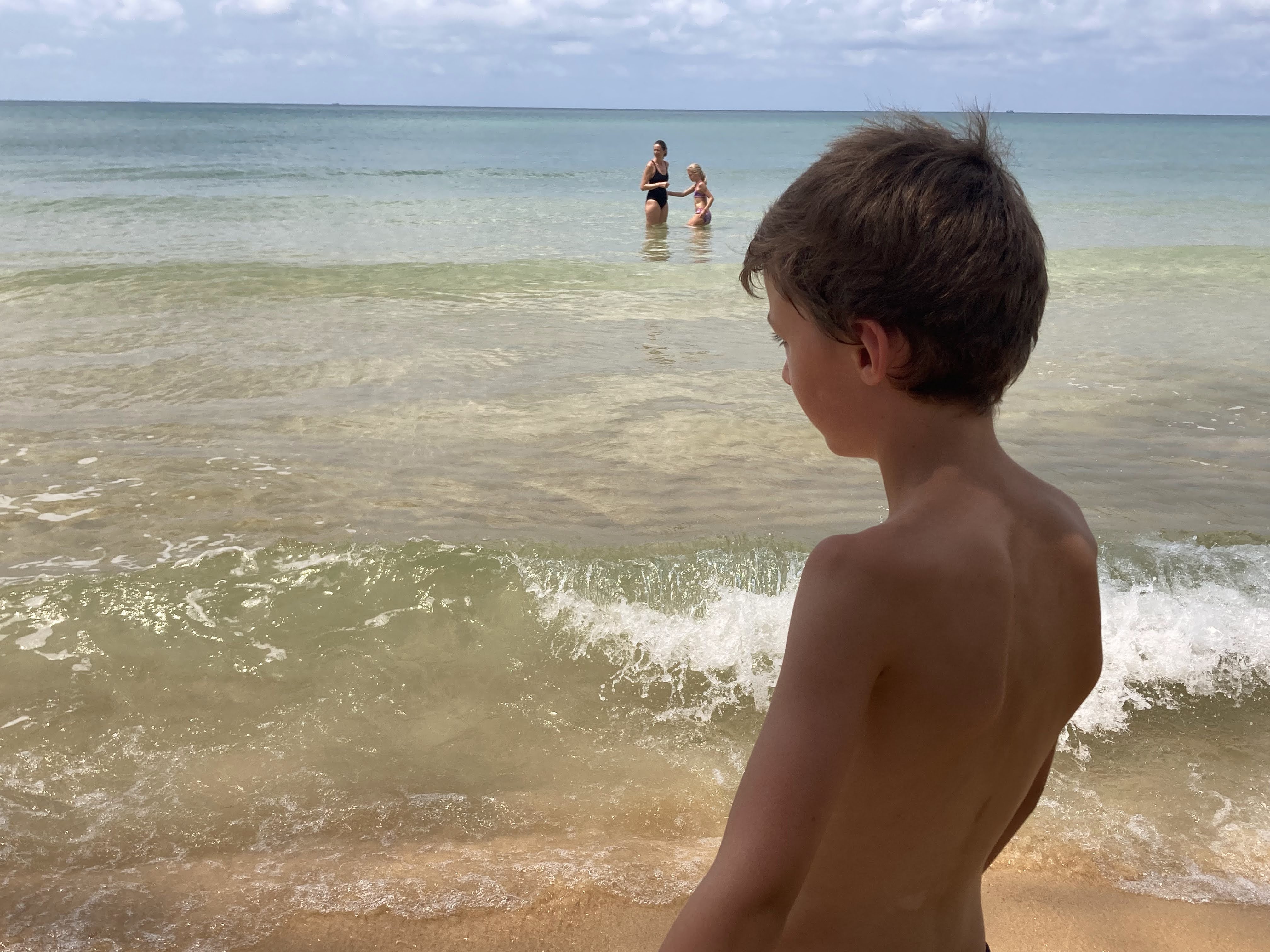

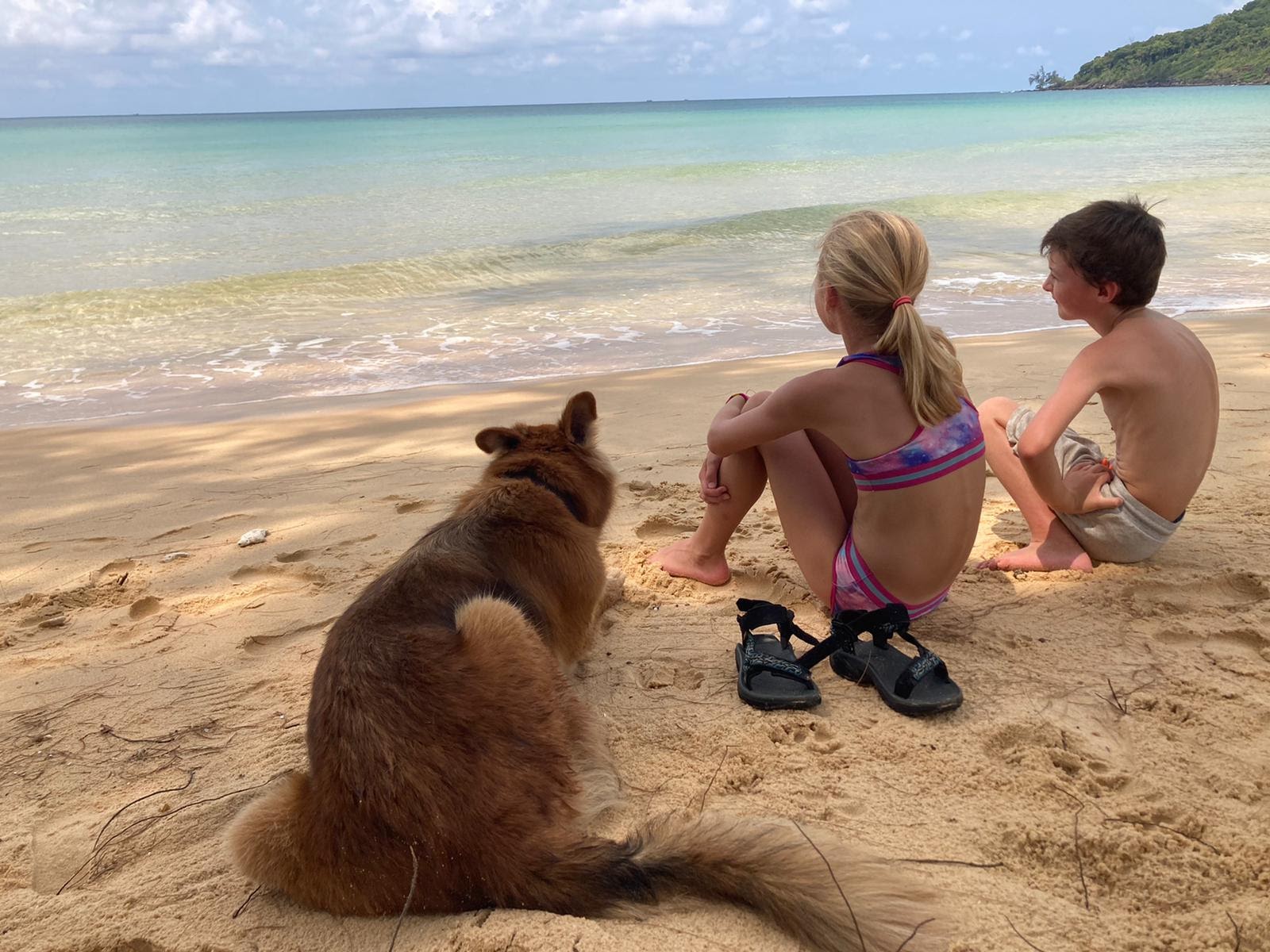
Anna and Arthur have quickly adapted to the new rhythm. Waking up, wriggling out of their mosquito nets, ordering their favorite pancakes for breakfast (“Can I have a chocolate pancake with bananas on the side, please?”), doing a bit of homework, and then doing nothing all day: building sandcastles, going in the water, swinging in the hammock, going back in the water, playing with the dogs, reading a book, playing cards, and swimming again. Slowly, their skin takes on a caramel hue.
We’ve come to appreciate the Cambodian art of sleeping anywhere, anytime. The worker currently repairing the bungalow next to ours regularly dives into his hammock as soon as the electric drill becomes too heavy under the heat. The island drifts off to sleep like in a fairytale, and we doze off with it.
Despite the laziness that seems to be the island’s motto, it isn’t typically a Cambodian virtue. Cambodians generally work very hard, often as a family. Each family runs its own business, whether it’s a taxi, a tuk-tuk, a dry cleaner, a restaurant, or a mix of these. Mothers manage to get their work done with one, two, or three kids hanging around them. At our favorite noodle restaurant in Phnom Penh, we were amused to see the entire family contributing to the small business. From the youngest, barely 4 years old and dressed as Spiderman, to the grandmother, well over 70, who might not be entirely sure what she’s doing but still gets it done. Everyone works or tries to work. And if the customers are slow to come, a quick nap is always an option—in the tuk-tuk, sprawled across a motorbike, behind the counter, in a hammock strung from the truck’s mirrors, under the house, between two trees, or anywhere a hammock can be hung.


From time to time, we overcome our laziness to take a walk around the island. This time, we chose Lazy Beach. We had a bit of help from TomTom—the aptly named—who led the way, much to the children’s delight. It’s a long walk under a blazing sun. Arthur and Anna, feeling the heat, take off their T-shirts. TomTom waits for us at every turn. Along the way, we pass several construction sites where new resort hotels are being built. The COVID crisis had the side effect of allowing developers and investment companies to buy up large parts of the island. The neighboring island of Koh Rong is expected to become the new Bali within the next decade. There’s even talk of an airport on the island. The thought makes us shudder.
Lazy Beach is on the other side of the island. Here, there are waves, corals, a beach hotel, and the same laid-back vibe as Paradise. We spend the afternoon jumping in the waves and decide, after checking our schedule for the coming weeks, to extend our stay on the island for a few more days at Lazy Beach. Why not?
At Lazy Beach, we meet Stéphane, a well-known painter and eternal optimist famous for his “Happy Painting.” He describes himself as a lazy person. “That’s why I became an artist,” he admits with a grin. He’s been in Cambodia for 20 years. He’s there with his son and his son’s friend, who are visiting him from France. Stéphane arrived in the 90s and never left.
As we travel through Cambodia, we encounter many like him. Young and old, often French, but also German, American, Spanish, or Australian—foreigners who, after spending time in this country, decided to leave everything behind and live here. Phnom Penh, Kampot, and now Koh Rong Samloem all have communities of expatriates enchanted by the country. They all speak of their admiration for Cambodians who, despite very difficult times, continue to smile and never complain. The pandemic hit the island hard, but everyone remains positive and looks to the future. “Smile! Happy!” the Cambodians say to us. It’s easy to live here, and it’s tempting to stay, but for us, the journey must go on.

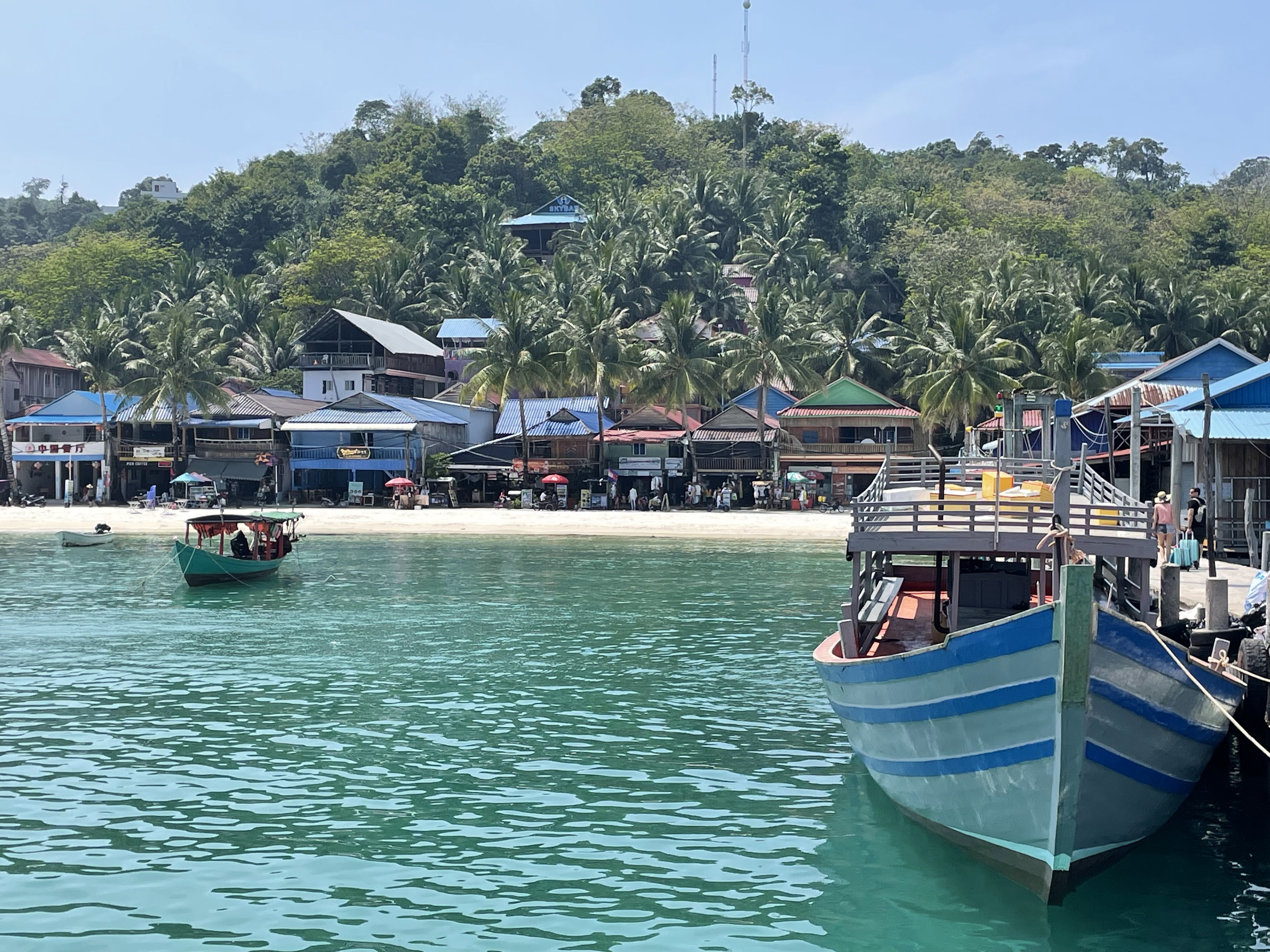
After eight days, we take the ferry back. We are completely rested and excited for all the beautiful destinations that still await us, starting with one of the wonders of the world, Angkor Wat. Our preparations for America are also nearly complete.
When the ferry docks, we once again play the tightrope walkers on that same narrow plank. It was a beautiful stop, but our journey continues.
As the ferry pulls away from the pier, we take one last look back.
On the beach, we see TomTom, napping under his coconut tree.
 Globetrotterdammers