

It’s Friday, and today we’re in Udawalawe. Udawalawe National Park is one of the most beautiful natural parks in Sri Lanka, home to a large population of elephants. After a jeep safari through the park, we visit the elephant orphanage, a sanctuary where orphaned or herd-rejected elephants are cared for until they are ready to return to the wild. We are seated on bleachers around a fenced enclosure. The benches are filled with children and their parents. It’s school vacation in Sri Lanka, and the seats are packed. Cheers erupt as the first elephants come running in. The caretakers place a tube in their mouths, and milk spills out onto the ground as the elephants gulp it down, draining the funnel in big, eager swallows. This scene repeats about 25 times until all the elephants are full. Among them, an older female tends to the youngest member of the group, a calf less than a year old. She isn’t his mother, but her maternal instinct is clearly well developed, and she constantly protects the little one. From the stands, we hear “Aaaahhh” and “Oooohh.” Anna and Arthur melt at this adorable sight.
In the small museum that belongs to the orphanage, we learn all sorts of educational and fun facts about elephants. “Elephants can comfort other elephants by caressing their heads with their trunks if one of them is stressed or worried,” explains Anna as we stand in front of a drawing of two elephants hugging each other with their trunks. “Elephants, like humans, are very social animals and need contact,” reads the caption below. A bit further on, the kids learn that one of the most expensive coffees in the world, from Thailand, is made from “elephant dung.” “Eww,” exclaims Arthur when we explain what that means.
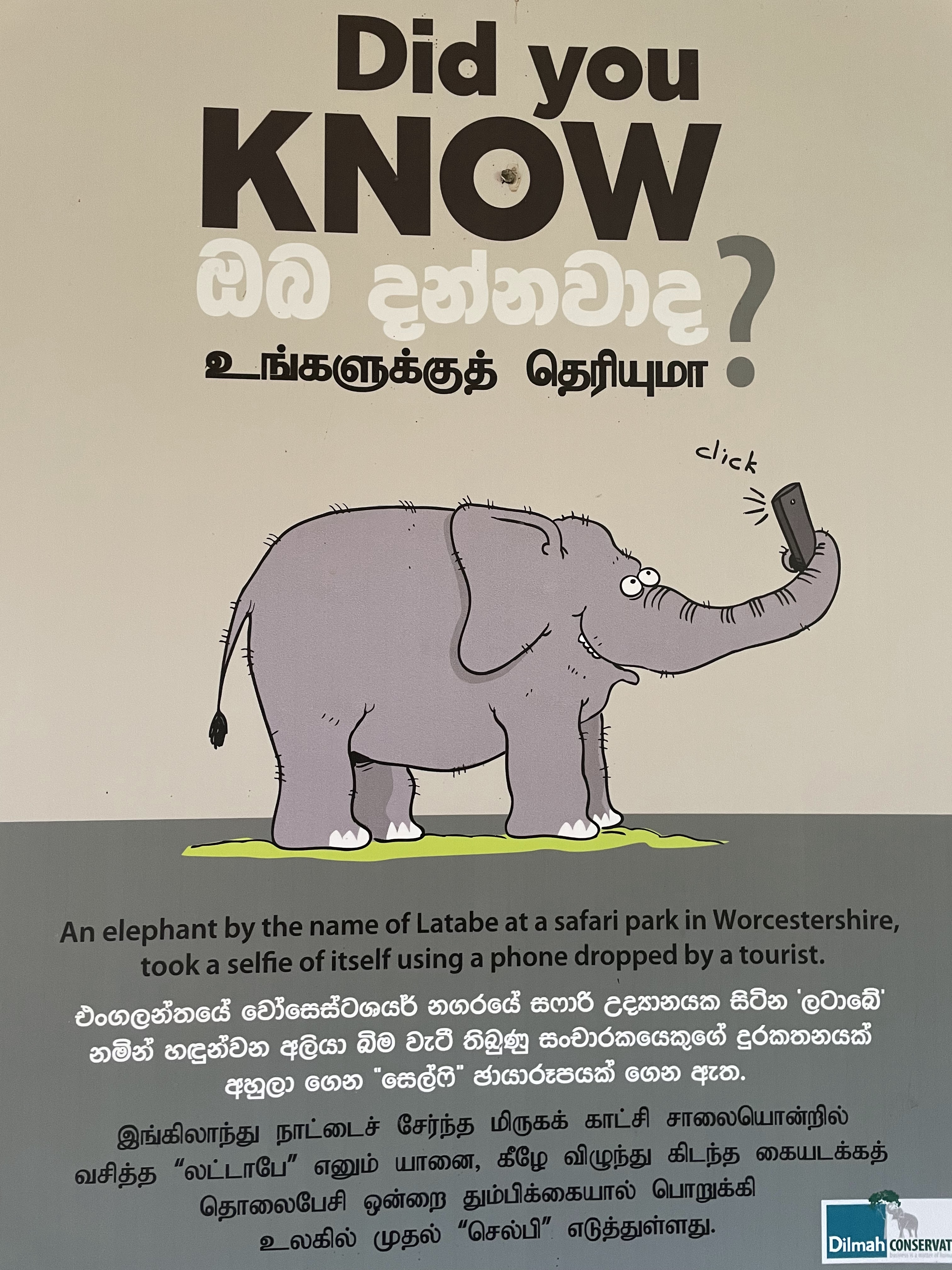
On the way out, we stop to read the final display board. “Selfie,” say Anna and Arthur in unison, as we laugh at the photo of an elephant holding a phone in its trunk, illustrating the feat of an elephant named Latabe at a safari park in England in 2014, who took a selfie with a phone a visitor had dropped. Elephants really are just like us!
Here, too, everyone has a mobile phone. Everywhere we go, we see boys and girls around 14 years old glued to their phones or taking selfies, posing in front of the sea, a building, or anything that might be interesting to post—like a family of Europeans on vacation in Sri Lanka.
“Please, can we take a photo?” Another selfie. He holds his phone at a slight angle so everyone fits in the frame. We’re in the background, smiling broadly but also a bit awkwardly. In front of us, the whole family: dad with a child in his arms, mom, and two teenage daughters. Then there’s Anna and Arthur, who, as usual, are squinting in the bright sun. And in the foreground, with his cap and chain around his neck, the eldest son, capturing it all. A serious, slightly provocative look on his face as he snaps the shot. The perfect photo for Instagram.

The first time we were asked this question was in Karak, Jordan, then in Oman, and now more frequently in Sri Lanka. We imagine it’s because we’re a traveling family with two kids, or maybe because of Anna’s blonde hair. Other travelers without children don’t seem to get asked as often. Whether in a Buddhist temple in Anuradhapura, the botanical gardens of Kandy, in front of the cave temples of Dambulla, or just somewhere in the mountains or countryside, families always want to take a photo with us.
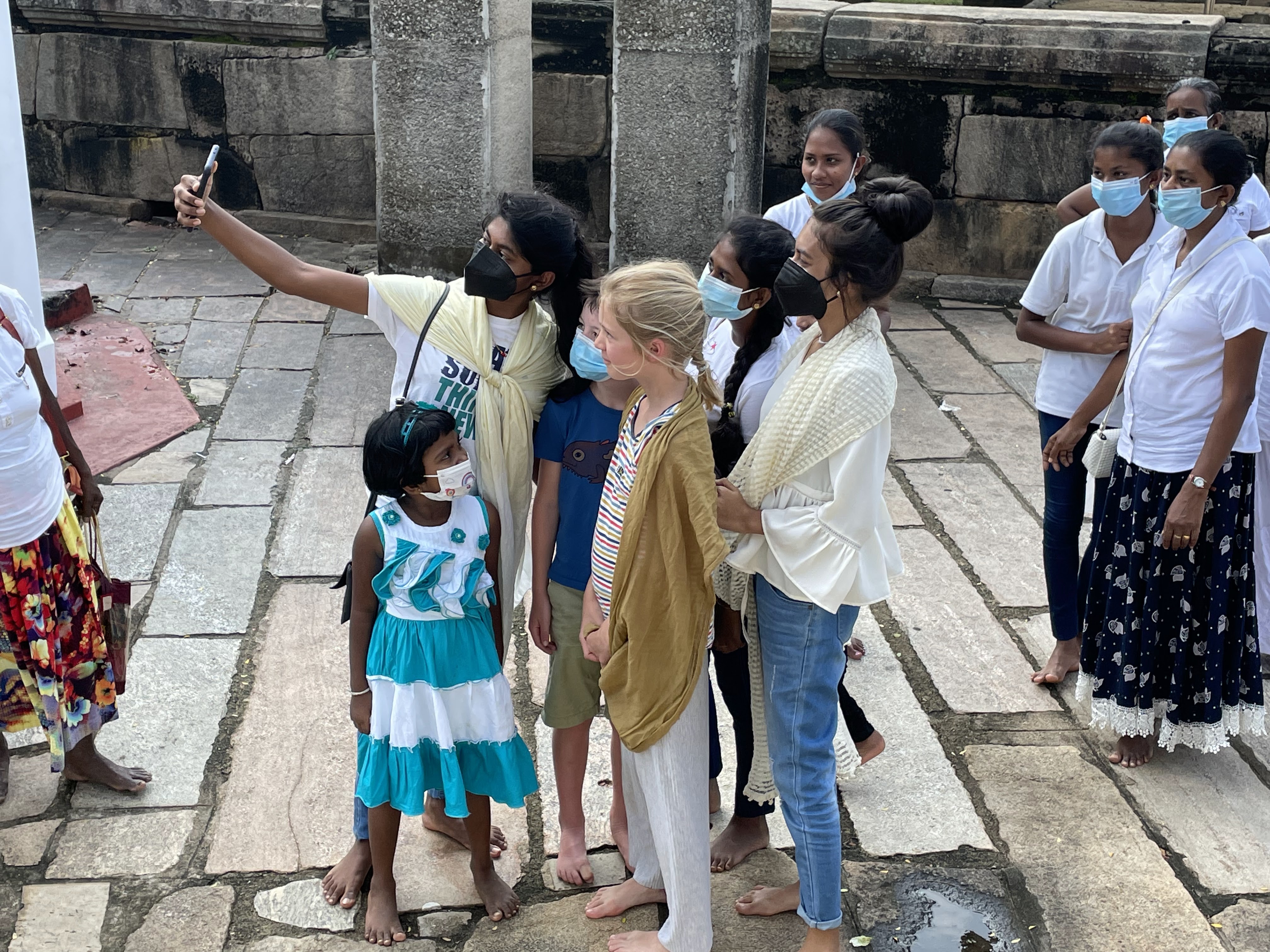
In Anuradhapura, a group of young girls asks if they can take a selfie with Anna and Arthur. “Well, ask them?” The kids agree, and they step forward like two little stars visiting Sri Lanka. There’s a mix of surprise and amusement on their faces. The young girls, dressed in white for their temple visit, are between twelve and fifteen years old and gather around the children to take the photo. While Anna and Arthur look into the camera, a little girl of about five turns to watch them, her back to the camera. She seems awestruck.
One day, after yet another request, Marie-Laure decides to ask “why.” The father hangs back a bit, but the three women, with dark skin, long colorful saris, and broad smiles, reply that our children are so cute. “They almost look like dolls with their big eyes.” That’s it, then—our children look like dolls with their blonde hair, big bright eyes, and fair skin. It’s an image they love to capture and share with their friends.
Some selfies are harmless, but while visiting certain sites, we sometimes witness other, more foolish and risky selfies. In Ella, for example, a popular destination in the central highlands of Sri Lanka. Ella is a small village with no more than three streets. There’s not much to do, but the atmosphere is relaxed. The village is nestled between mountains and tea plantations. Ella has its own train station on the railway line connecting Kandy to Badulla, a route many tourists take to enjoy the lush, green panoramas and the mountains that are difficult to reach by road.
In recent years, Ella has become a popular destination for backpackers and tourists. The village is rapidly developing, with cafés, guesthouses, and trendy shops, all with a laid-back, relaxed vibe. Just before entering the station, the train crosses the Nine Arch Bridge, a spectacular stone bridge with nine arches, built by the British, standing 75 meters high at its tallest point. The Nine Arch Bridge is one of the main attractions in Ella, and the passing train draws a lot of attention every day.
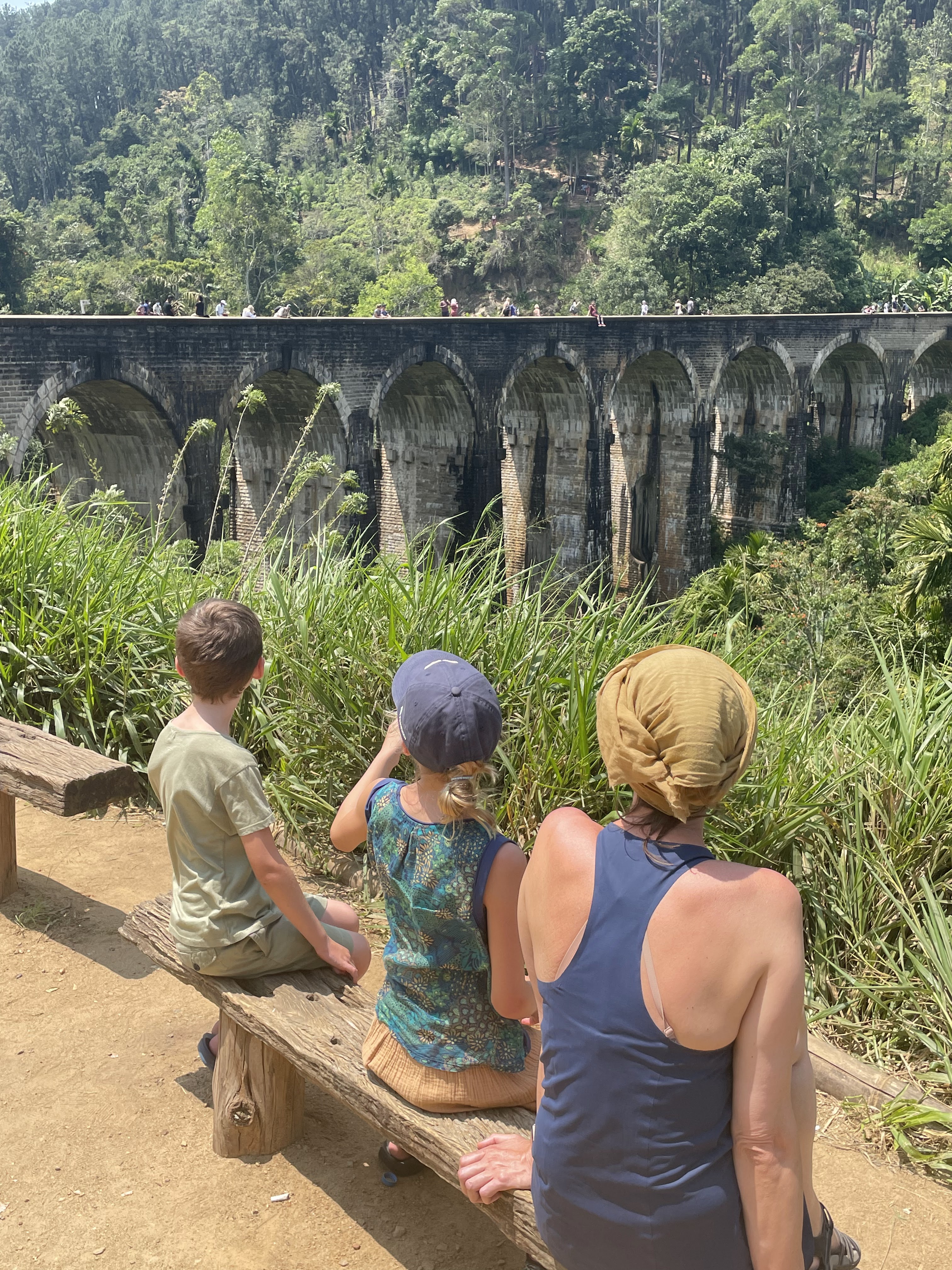
There’s already quite a crowd when we reach the bridge after a 45-minute walk. In half an hour, the train will pass. Alongside many tourists, there are also a lot of Sri Lankans. In February, most students have a few weeks off, and many people take vacations. A small group of young Sri Lankans in their twenties waits in the middle of the bridge. We watch the scene from a distance. One of the young men climbs up onto the one-meter-high edge of the viaduct, soon followed by two of his friends. It’s not the best timing. Two days earlier, the day after we arrived in Ella, a 27-year-old Czech tourist fell from the poorly secured balcony of a bar late at night. He didn’t survive the fall. For several days now, there have been discussions about the safety of the rapidly multiplying hotels, bars, and guesthouses, as well as the reckless behavior of some people, especially the young. While the boys stand on the edge in their flip-flops, one of their friends takes photos. I can’t bear to watch. One wrong move, and it’s over. Ten meters away, a girl dangles her feet over the void. Lying on the parapet, she smiles at her friend. Click, click, click! I wonder why so many people are willing to risk their lives for a photo.
The only thing that matters to them is the power of the image they’re trying to convey. Strong and tough, beautiful and elegant, or slim and sensual. And if the photo turns out well, it gets posted on Instagram, Facebook, or TikTok.
In the end, elephants aren’t really like people. They’re much smarter.
 Globetrotterdammers