

We’re eating ice cream on a terrace in Siem Reap, a city in northwest Cambodia from where we’ll visit the temples of Angkor Wat. The kids have just ordered a scoop of vanilla ice cream for Anna and a scoop of chocolate for Arthur. Always the same. We try to encourage them to try something new, but it’s no use. One scoop of vanilla, one of chocolate.
As the kids enjoy their ice cream, Marie-Laure and I reflect on our journey so far. We’re almost halfway through. What have we gained from the trip? Have our expectations been met?
We’ve enjoyed each of the countries we’ve visited. Some, like Jordan and Oman, weren’t part of the original plan and turned out to be wonderful surprises. We feel fortunate to be able to experience this as a family of four, and we can see how much the kids are growing from this adventure. At the beginning of the trip, they were sometimes a bit unsure of themselves, but now they’re more confident and approach everything with enthusiasm. They take turns ordering food and drinks whenever we go somewhere. Especially Arthur: “Can I sugar please?” or “Can I menu?” We often burst out laughing, while he looks at us with a stoic but proud expression: “So what? She understands me, right?”
As for what the journey has brought us, that’s harder to answer. We’re not quite sure yet. Maybe we haven’t had the time to sit down and think about it calmly. But the trip has certainly opened our eyes, and the kids’ eyes too. Their small world has become much larger, enriched with many shades of understanding. They’ve learned what it’s like to grow up in a country other than the Netherlands, about the opportunities we have that shouldn’t be taken for granted. But also about the beauty and cultural richness of these countries, the kindness, hospitality, and positivity that people radiate despite their poverty. Not to mention that we’ve seen two of the most impressive historical and archaeological sites on the planet: Petra in Jordan, and this week, the temples of Angkor Wat.
Incredible Angkor Wat! In Khmer, it means the City of the Temple. Hundreds of ancient temples, hidden in the jungle, spanning an area 20 kilometers by 30. It’s the largest religious structure in the world. Between 800 and 1300, this city was the capital of the medieval Khmer Empire, which stretched far beyond present-day Cambodia, covering large parts of Thailand, Laos, and Vietnam. Around 1100, Angkor was home to a million inhabitants, a unique situation for that time. A few centuries later, the royal power moved to what is now Phnom Penh, and the city was forgotten. For hundreds of years, it lay dormant, and the temples were slowly swallowed by the jungle, until English and French archaeologists began rediscovering them one by one in the 19th century.
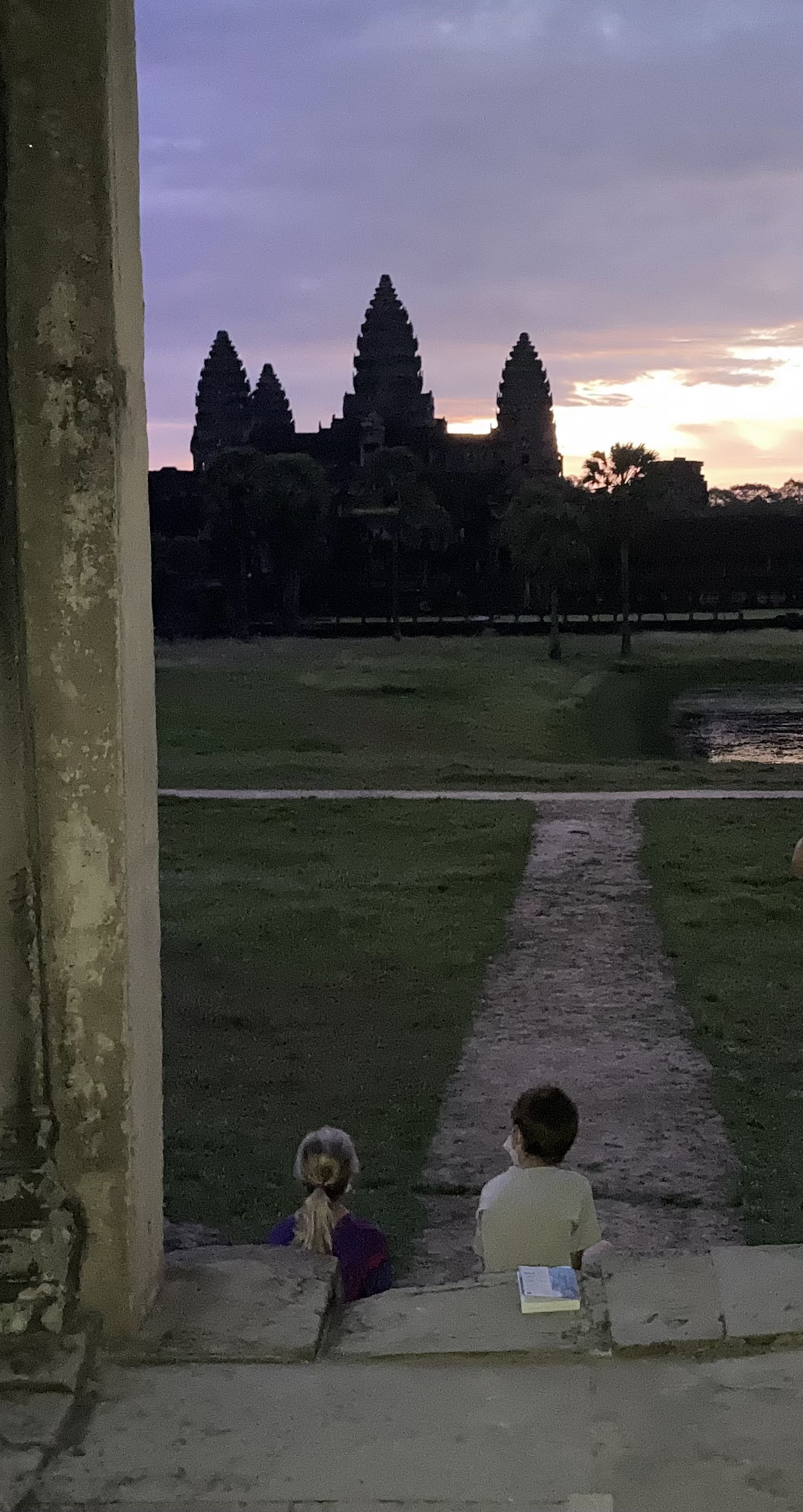

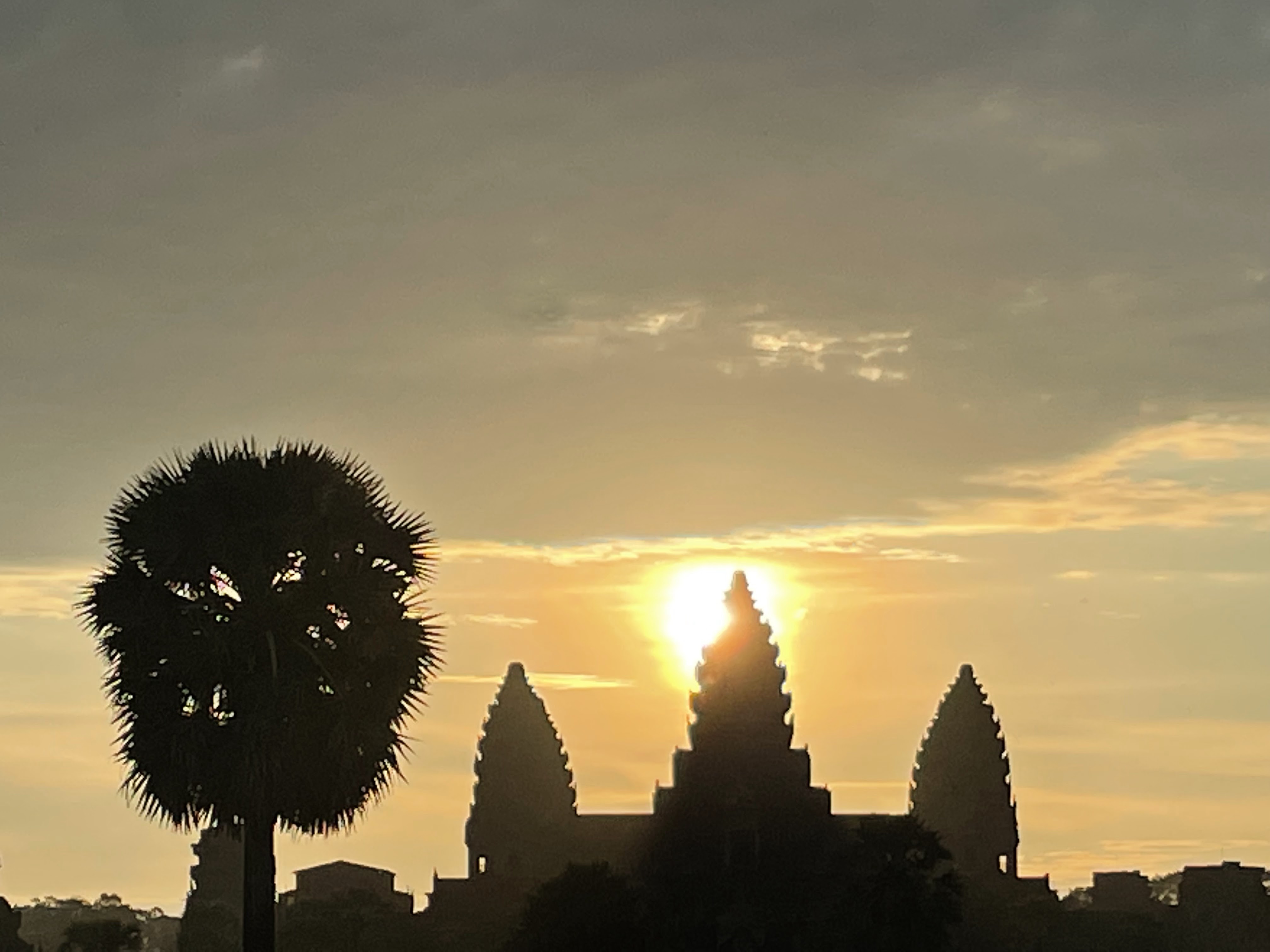
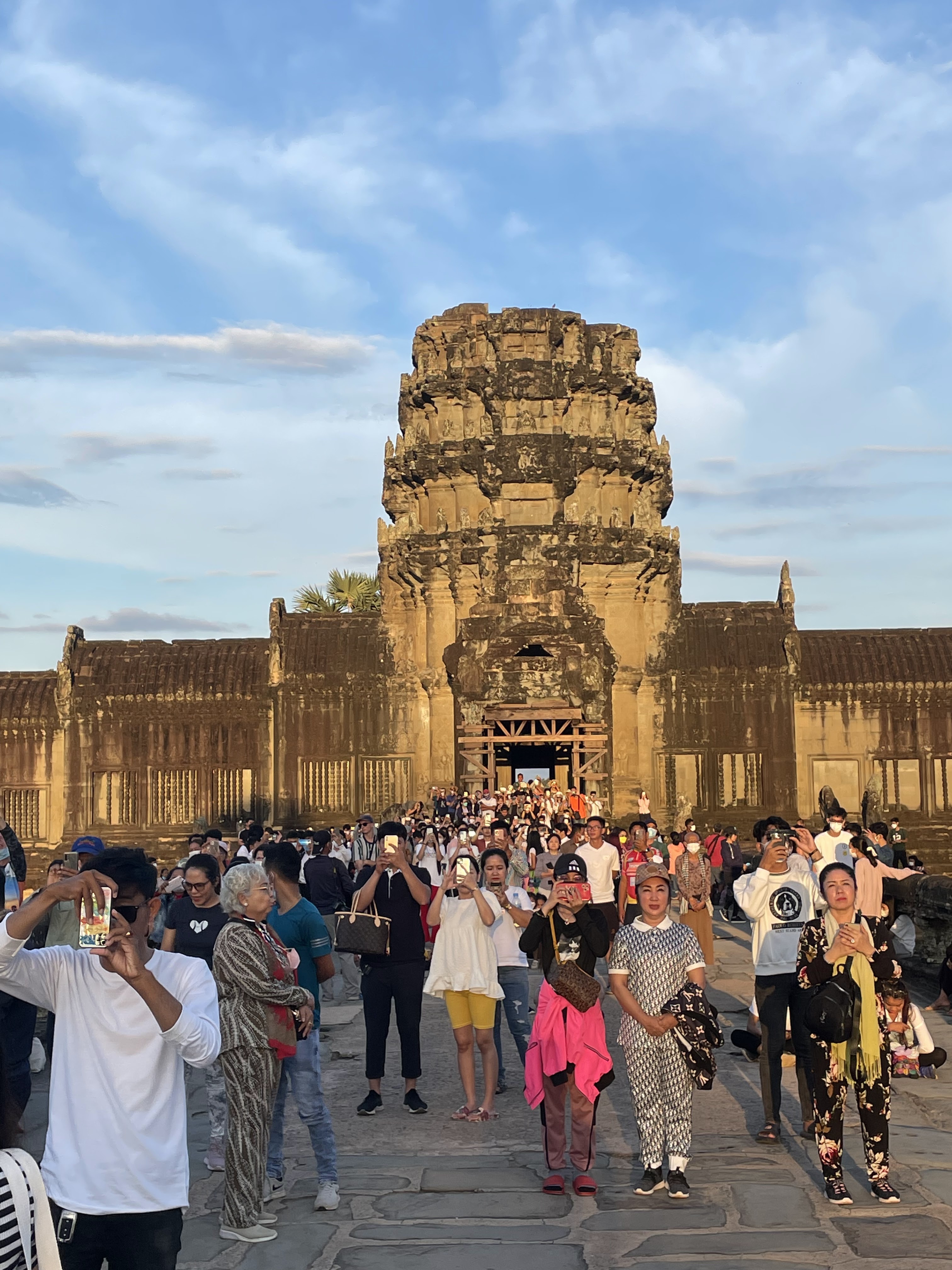
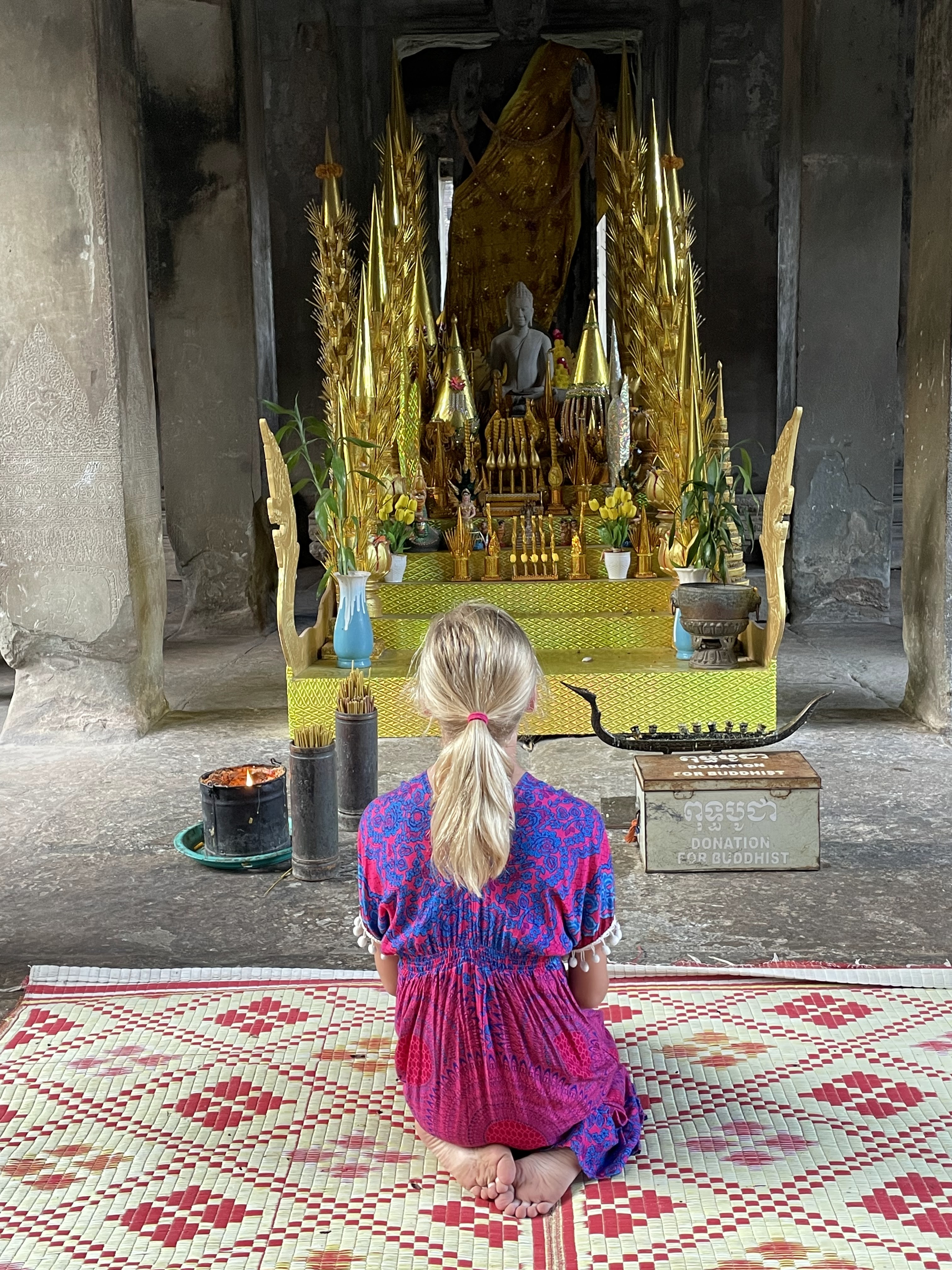
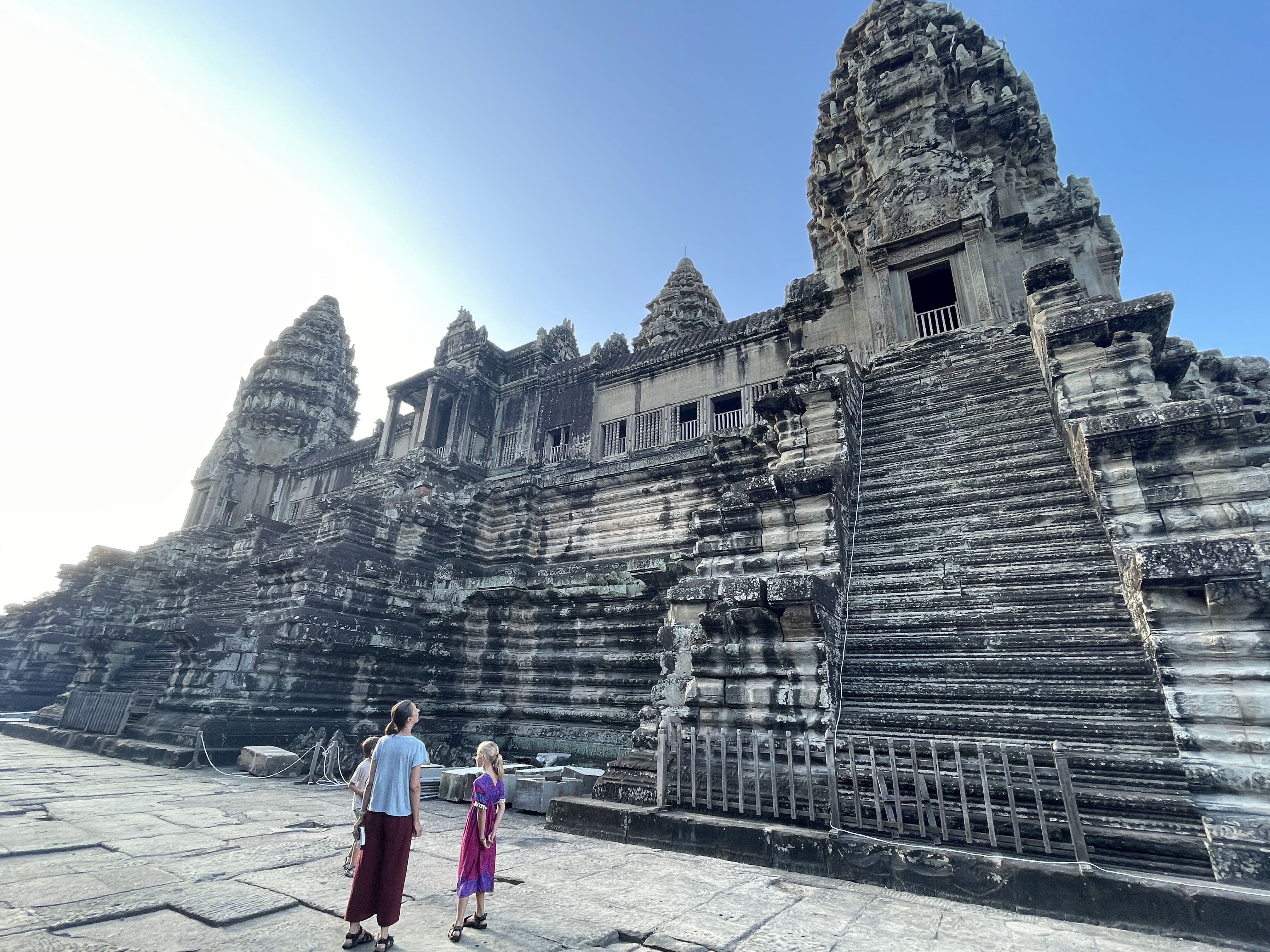
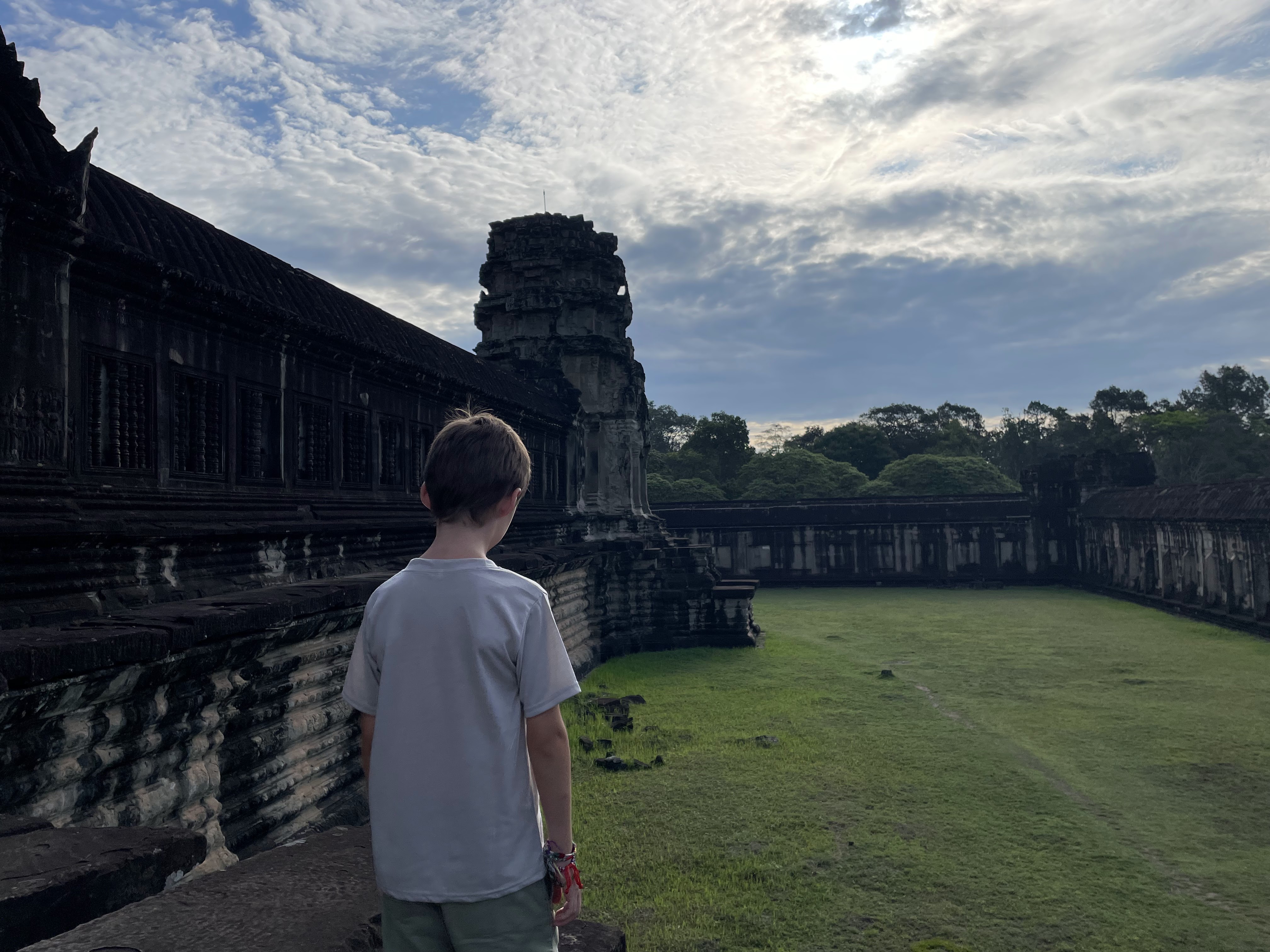

On the first day of our visit, we wake up at 4:30 a.m. to watch the sunrise over Angkor Wat. Twice a year, the sun rises exactly in the center of the temple. Sometimes, chance works in our favor, because without knowing it, we had chosen this special day to witness the sunrise at Angkor. As we wait for that unique moment when the light emerges from the temple, behind us, a hundred amateur photographers and local visitors are poised, ready to capture the perfect shot where the sun celebrates the site’s perfect symmetry. This symmetry is symbolic in Khmer Buddhism, representing balance, the center, and the absence of error. But as soon as the photo is taken and the light disperses, most of them leave, and we have the temple almost to ourselves. In the dim light of the temple, we kneel quietly before a statue of Buddha and light an incense stick. An incredible moment of serenity!
Usually, the temples are swarmed with hordes of tourists brought in by tour buses. But today, we are alone. The dawn and the absence of tourists lend an almost mystical atmosphere to these temples that rise out of the jungle and from time. The voices of the past seem to whisper their stories through the walls, and we imagine ourselves as explorers, searching for hidden treasures and ancient tales. Like Indiana Jones in his cursed temple. In silent wonder, we dream and fantasize about the time when these temples were still full of life.

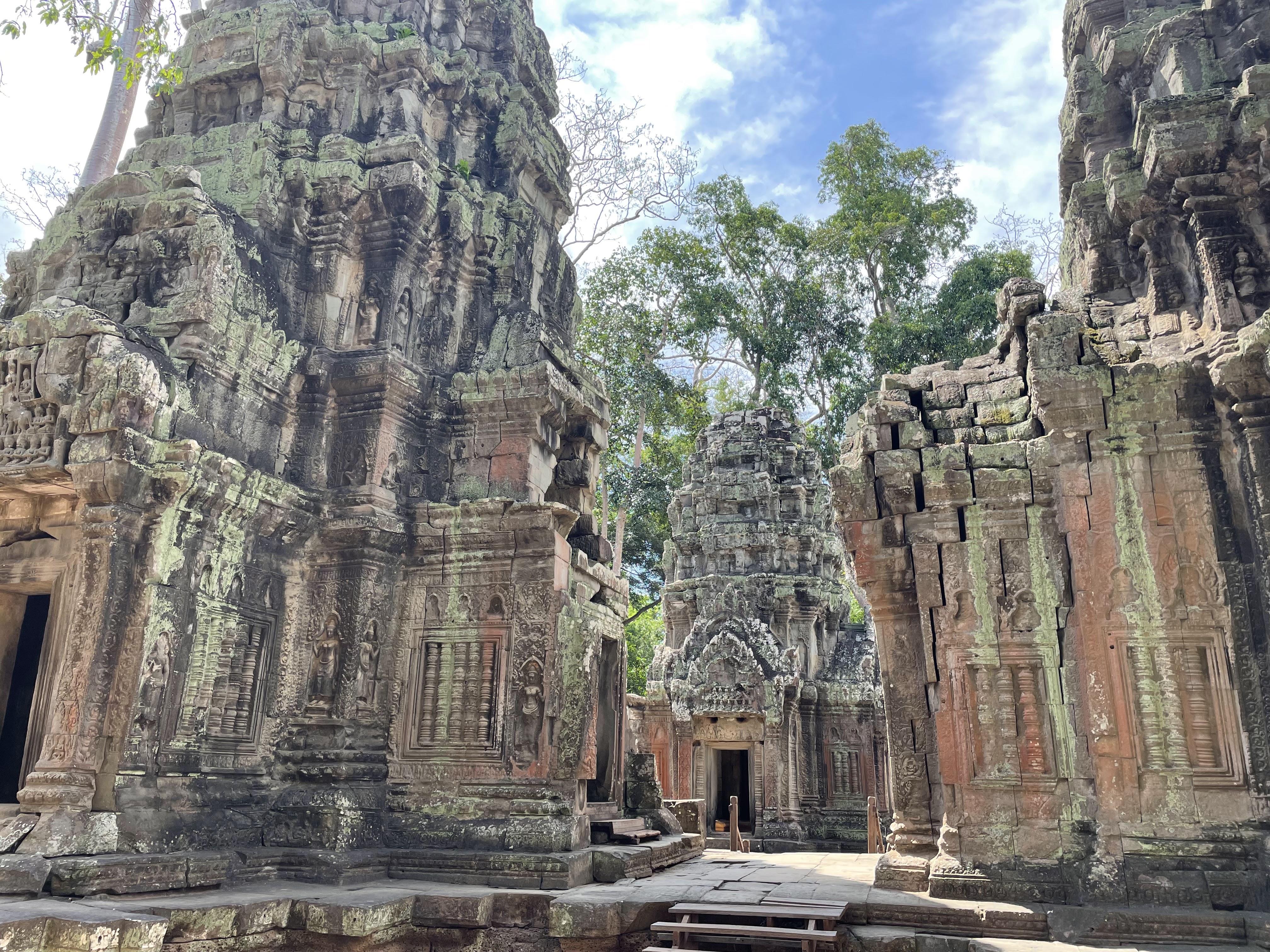

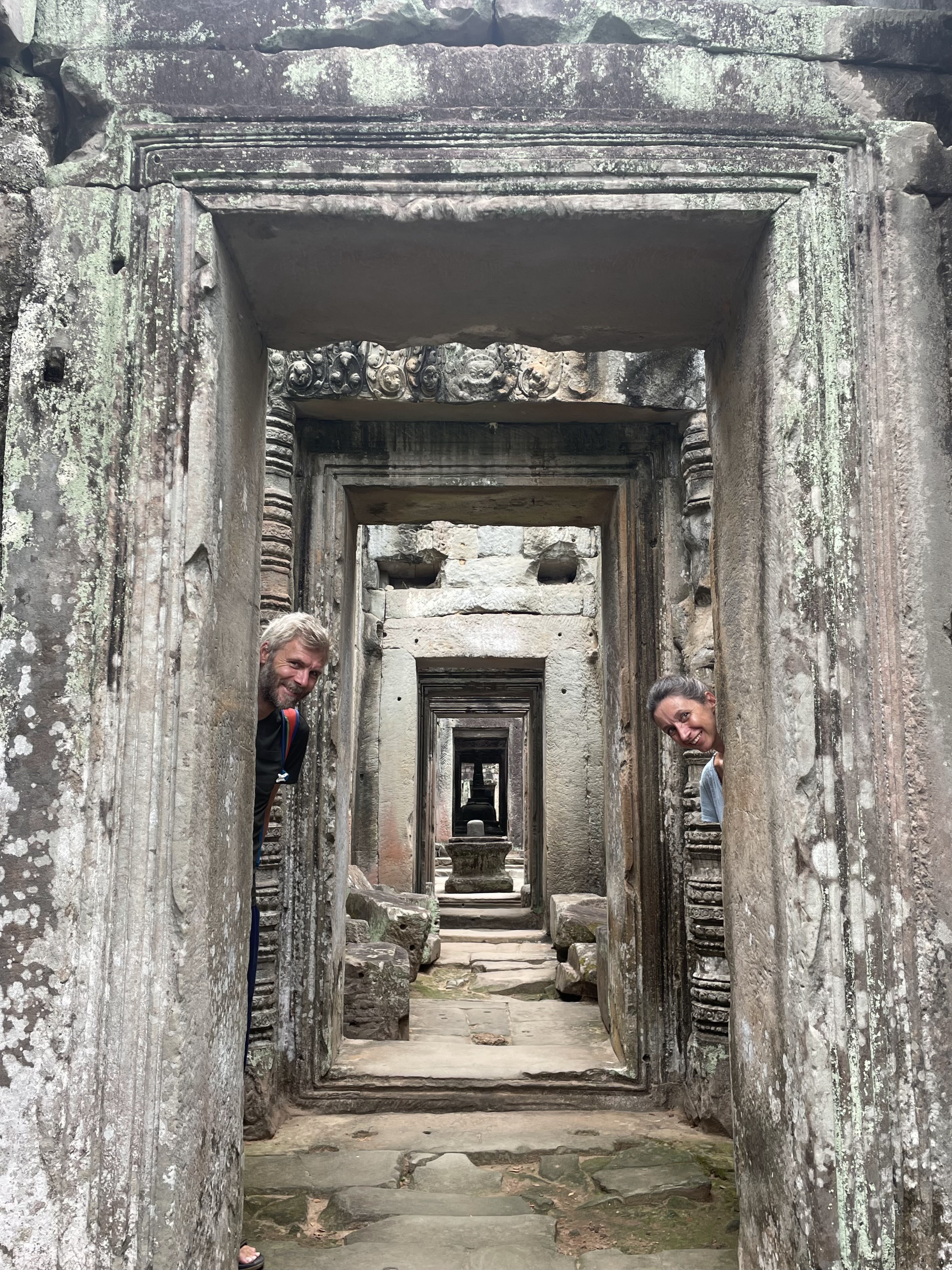

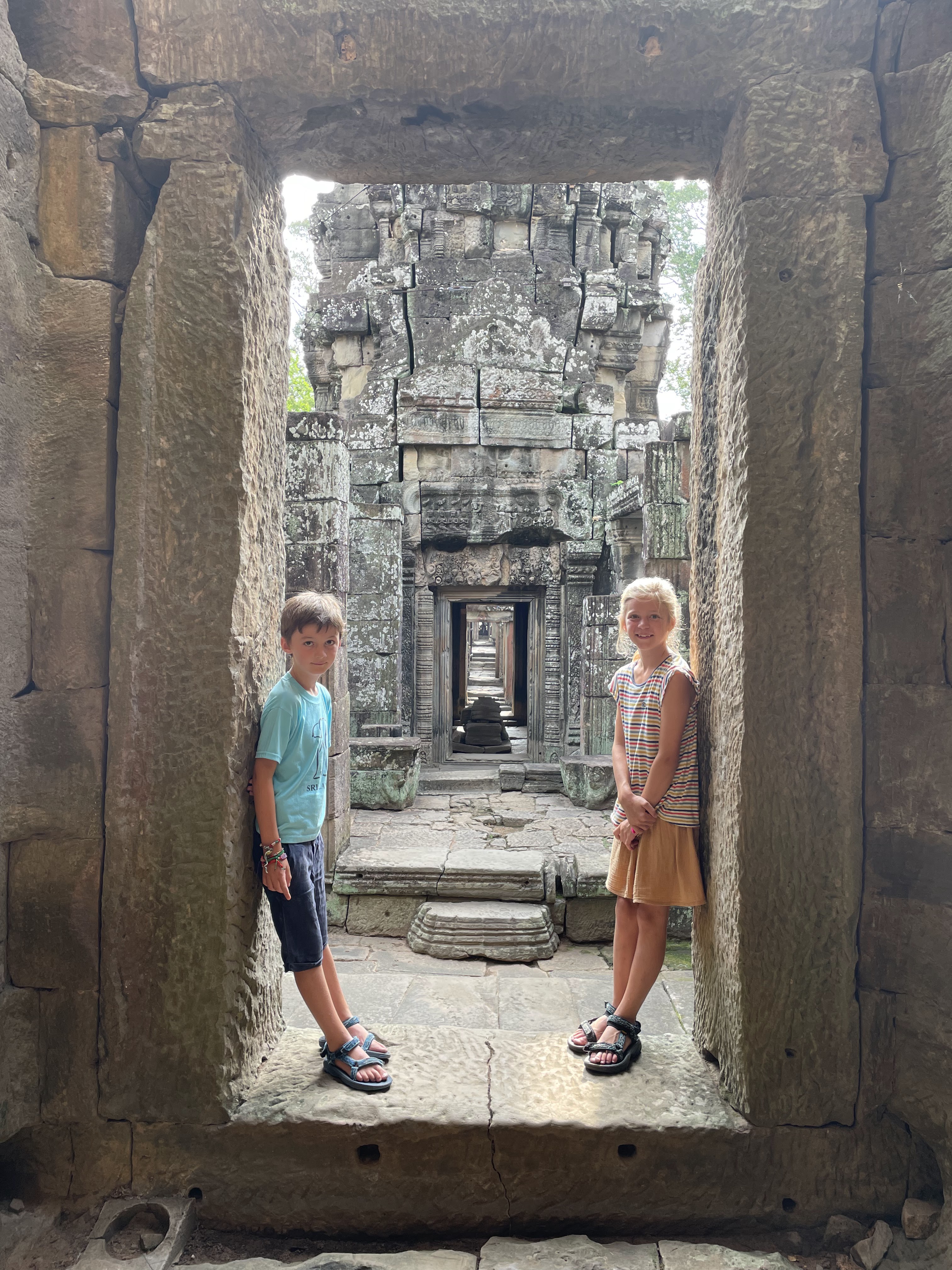
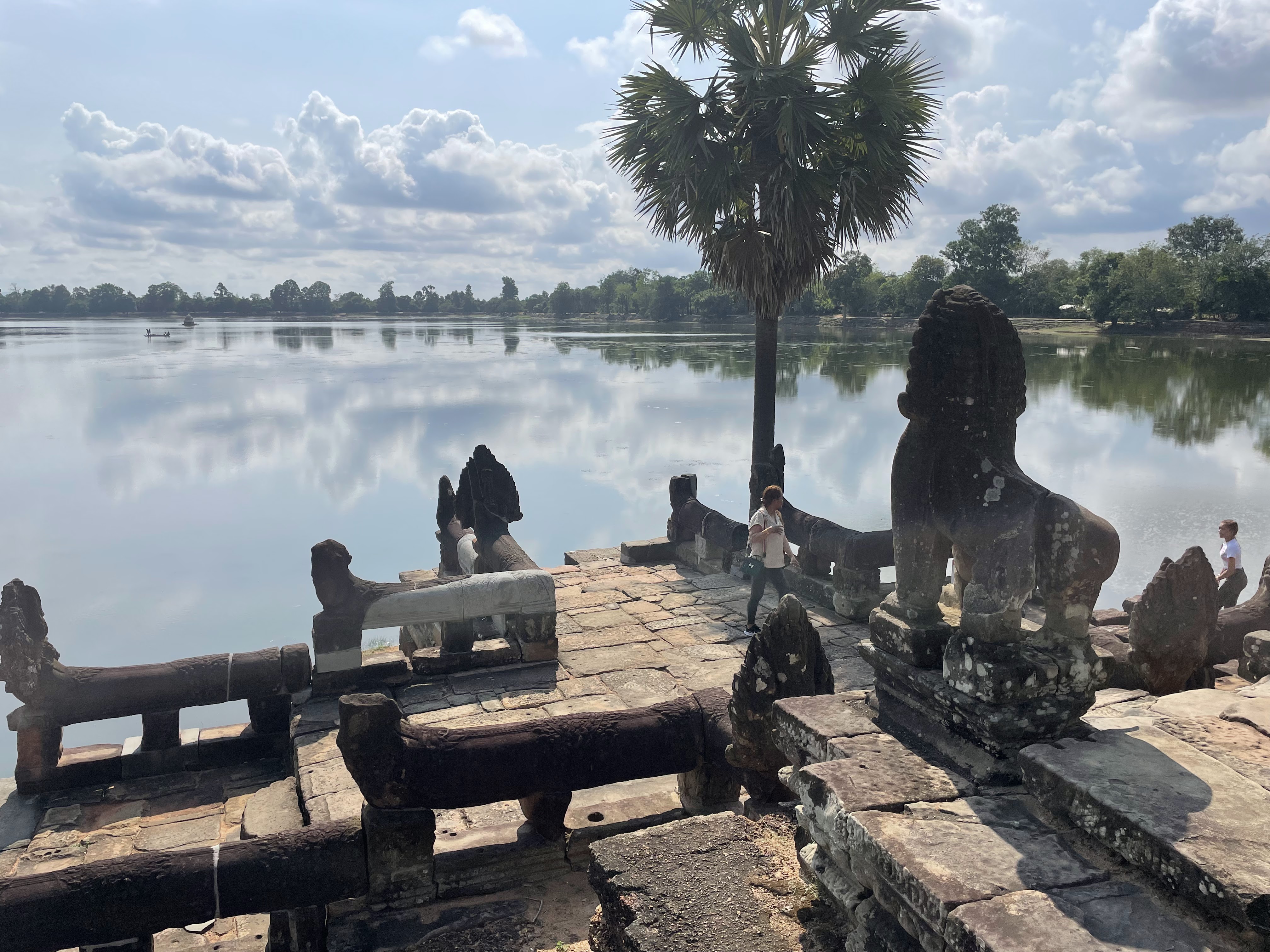
We particularly appreciate the absence of tourists because we have another challenge to face: the heat. It’s the end of March, the hottest time of the year in Cambodia. By 10 a.m., the temperature rises to 35 degrees. The tropical heat and humidity become unbearable. And since the temples are sacred places, we have to wear long clothing that covers our legs and shoulders. The only solution is to start early and spread out our visits between the morning and late afternoon. We usually head out around seven in the morning, visiting one or two temples by tuk-tuk. Then, after returning to the hotel for a refreshing dip in the pool, a good lunch, and the kids’ homework, we hop back in the tuk-tuk in the late afternoon for another visit.
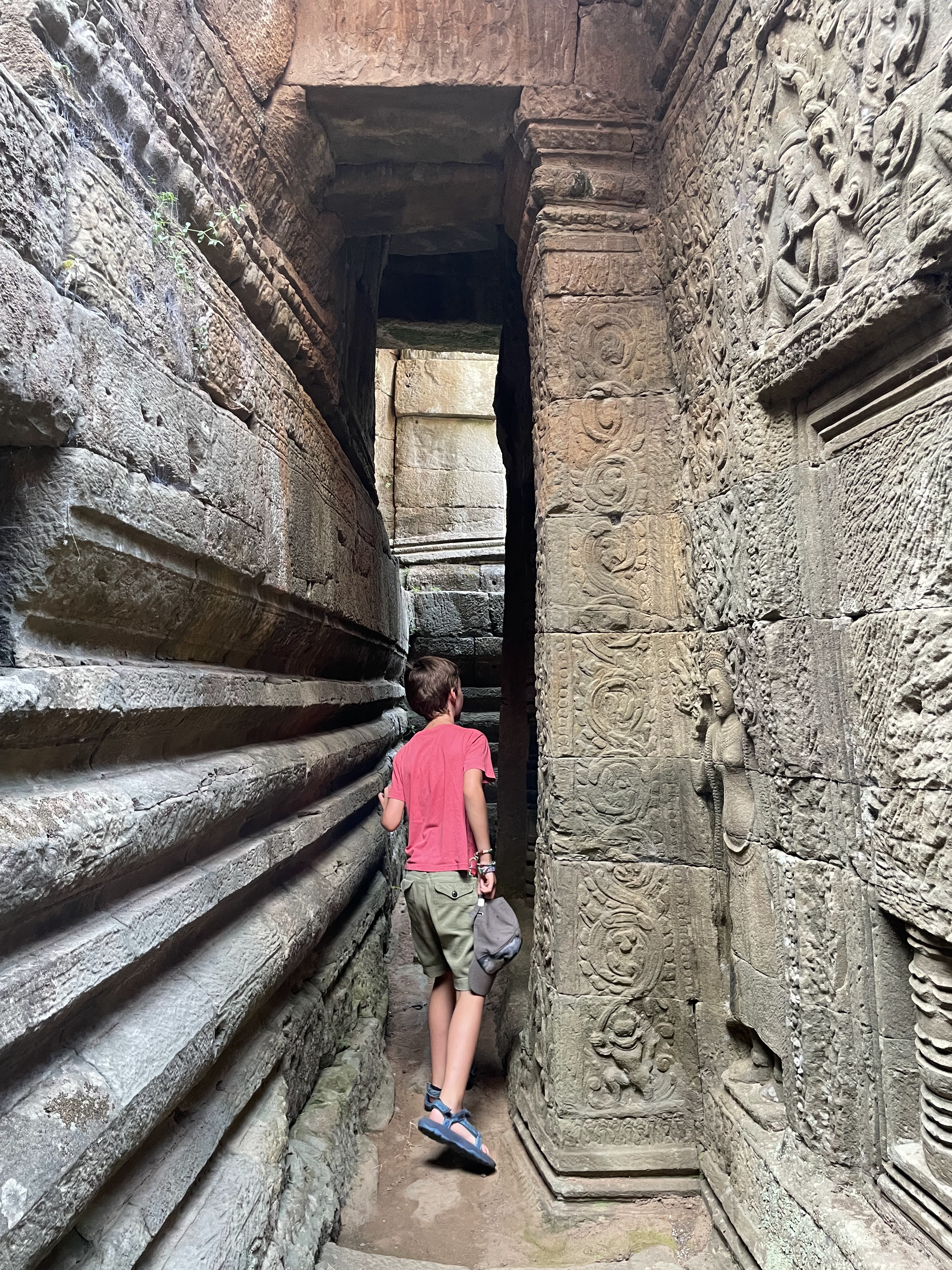
The kids love Angkor. You might think that after two or three temples, they’d have had enough—it all starts to look the same after a while—but the opposite is true. Marie-Laure and I do our best to explain the history of this ancient city. We search for bas-relief images on the decorated walls, organize creative photo sessions, and play games like “the floor is lava” or hide-and-seek in the temples. The visit becomes a game or an adventure. We even make up our own stories. Sometimes, the kids don’t want to believe that these stories aren’t real. Maybe one day, they’ll tell you about the story of the god of the belly and the sacred pineapple…
The Bayon, which we visited on the second day, is the temple that impresses us the most. This hilltop Buddhist temple has a mysterious air, with its pointed towers adorned with giant faces on each of the four cardinal sides. Like Angkor Wat, the Bayon temple is also surrounded by bas-reliefs. The images are so detailed that, for the children, it feels like a fascinating comic strip. They move slowly along the walls and through the corridors, taking in the details of the frescoes. “Look, it’s the seven-headed monster. It doesn’t look scary at all.”


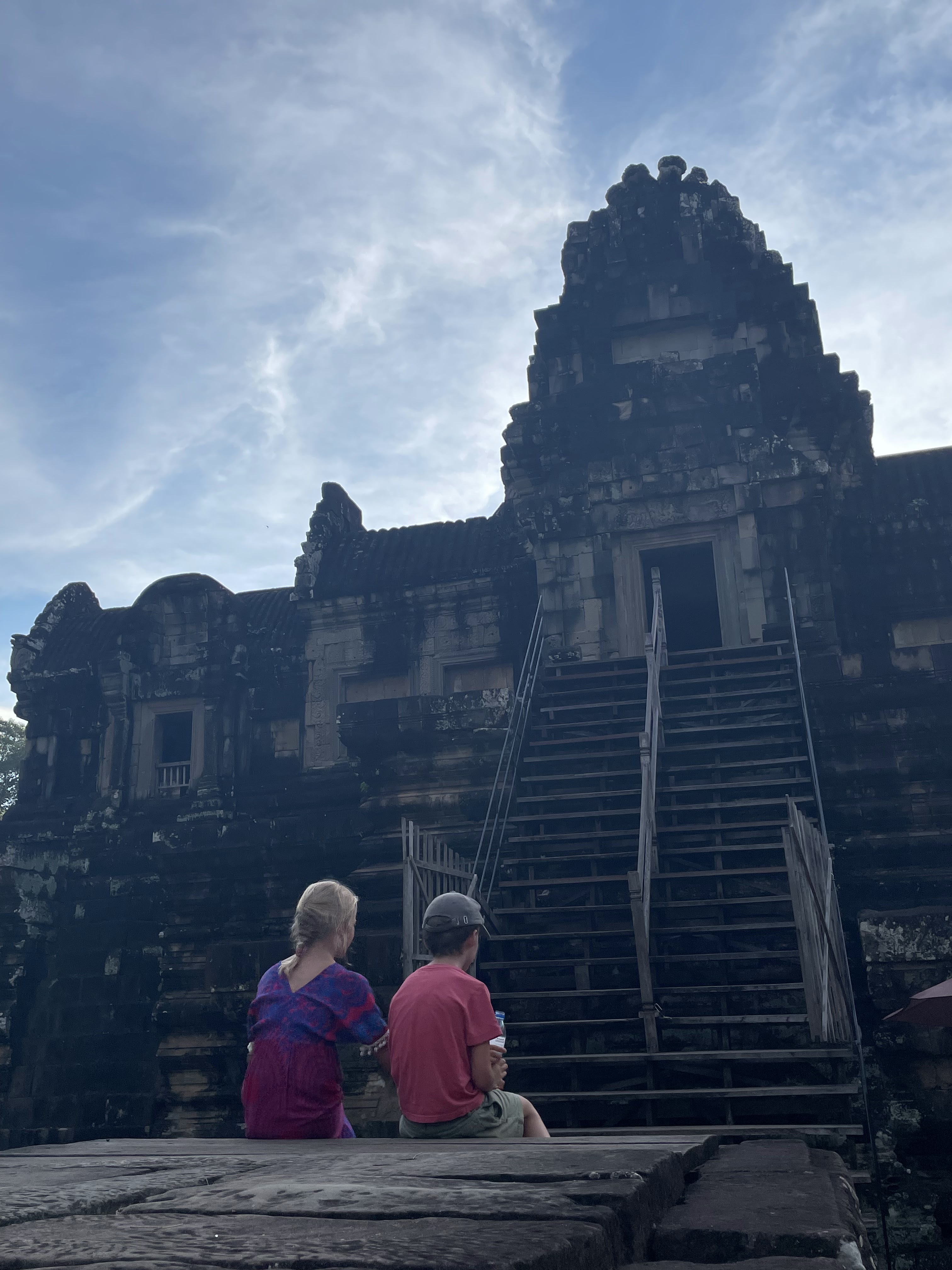
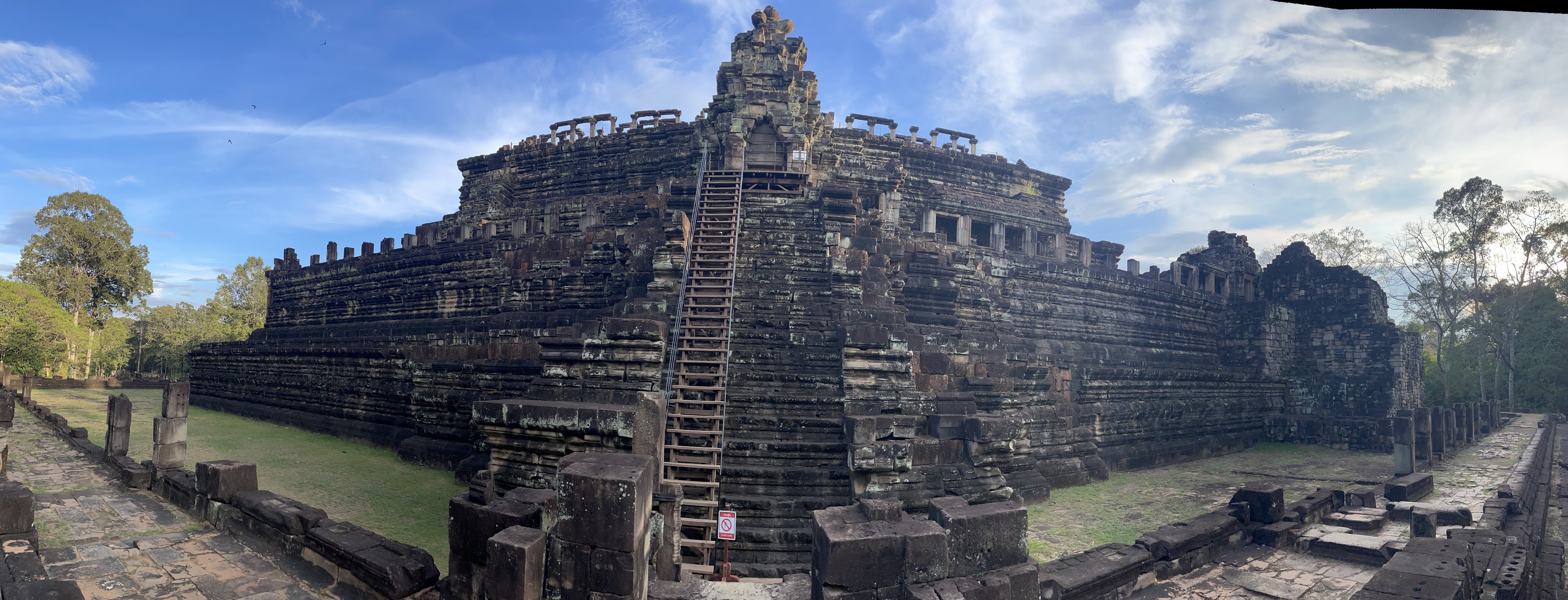
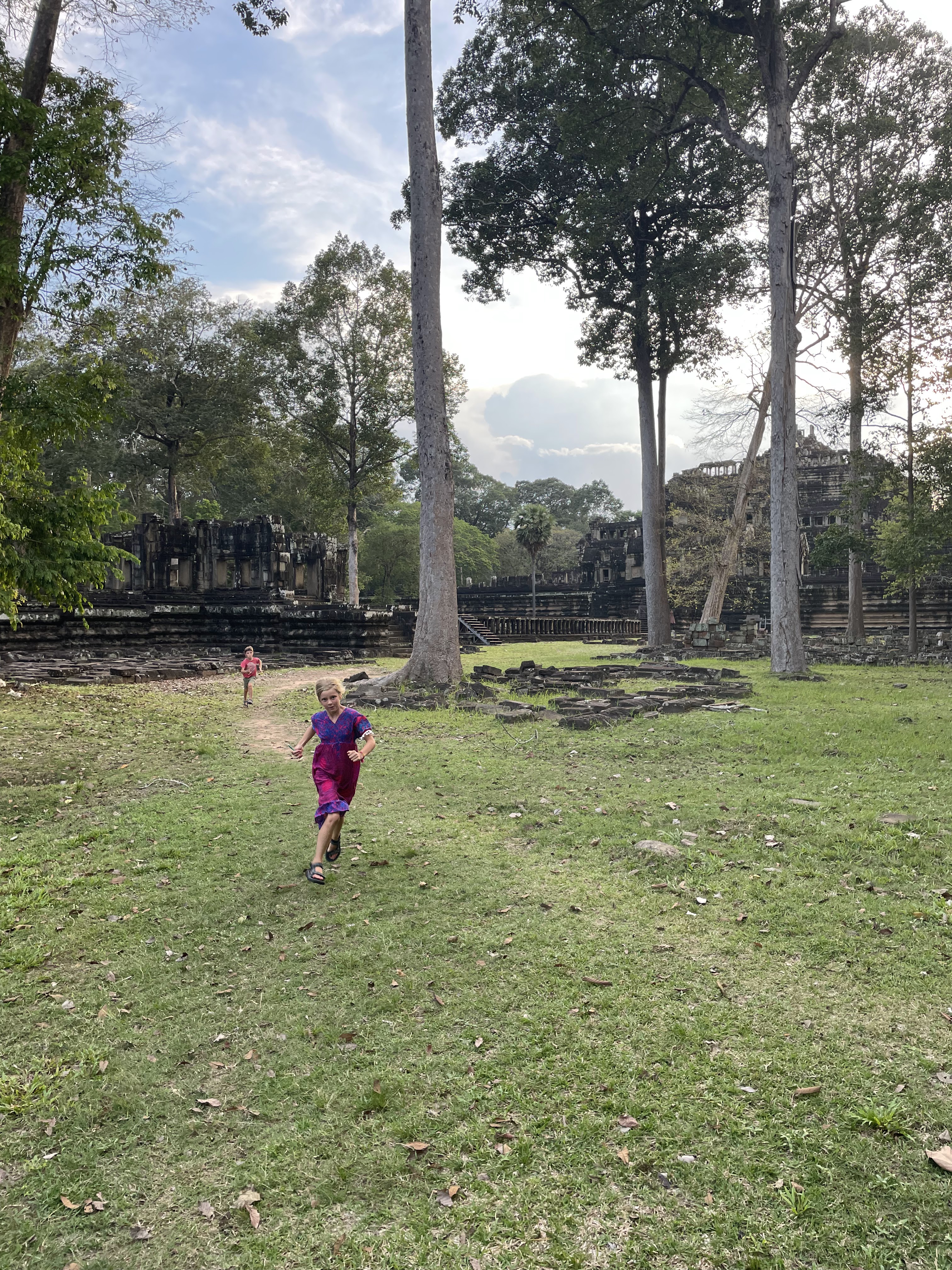
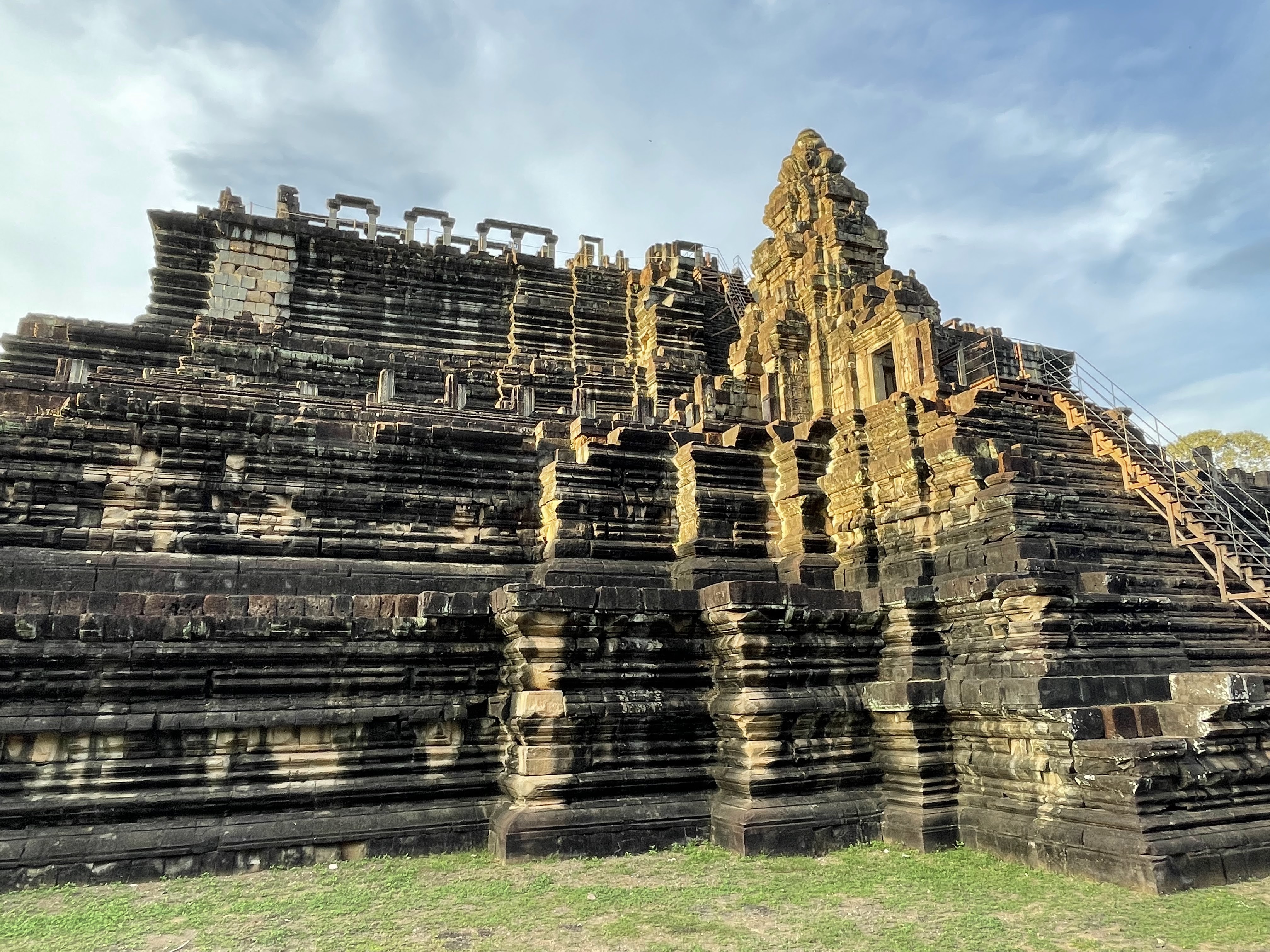
We also discover the incredible story of Baphuon, another hilltop temple shaped like a pyramid. This temple was in such poor condition that it was on the verge of collapsing. When archaeologists decided to dismantle it stone by stone for restoration last century, they counted and cataloged around 30,000 stones, which were laid out around the complex. Unfortunately, these records were destroyed in the 1970s under the Khmer Rouge regime. It wasn’t until 2011, 57 years after the restoration began, that they managed to complete the largest archaeological puzzle ever imagined.
At Baphuon, we are still alone. We climb the steep steps of the temple and watch the sun slowly disappear behind the surrounding jungle stretching out into the distance. What a sight!
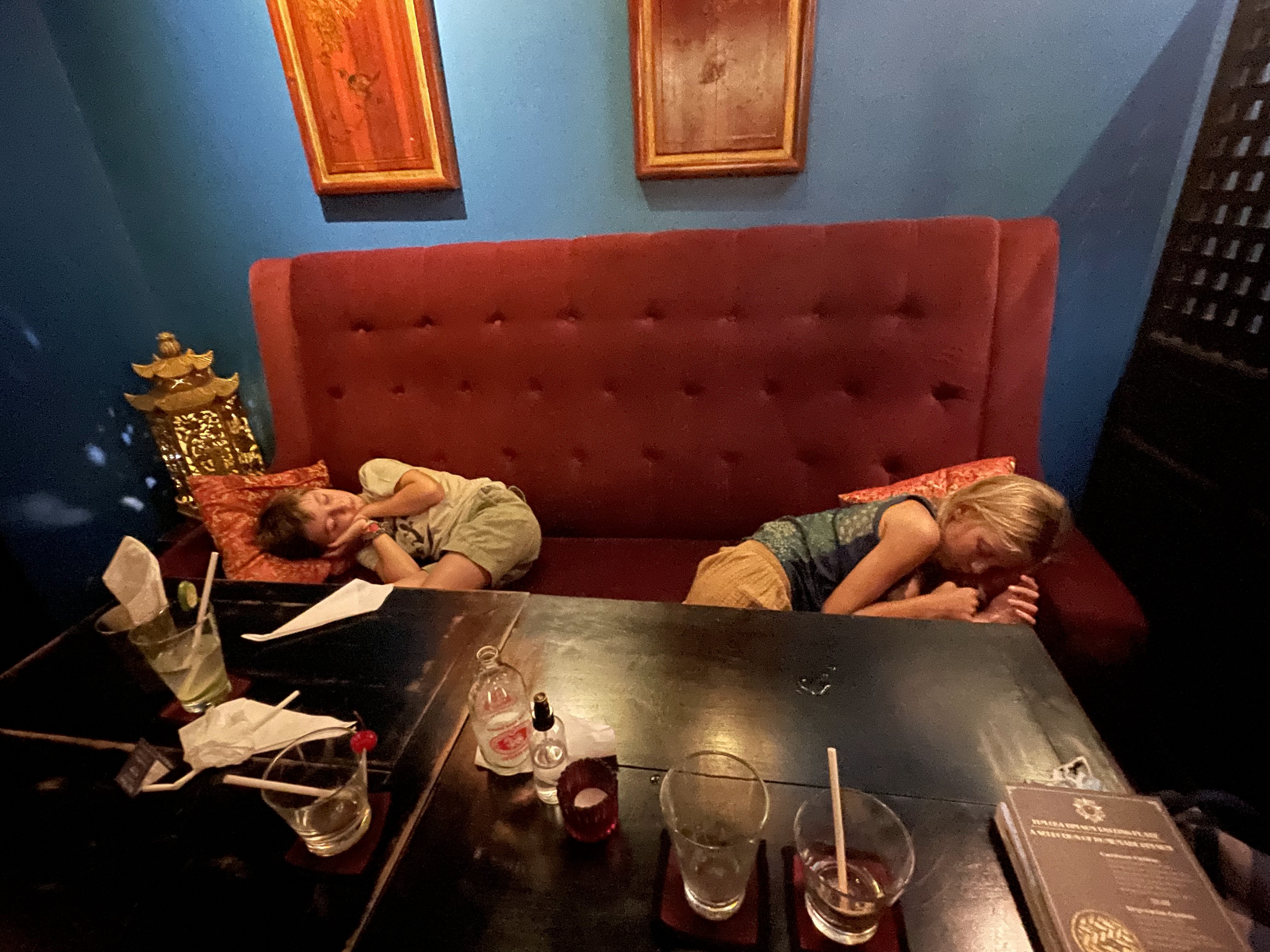
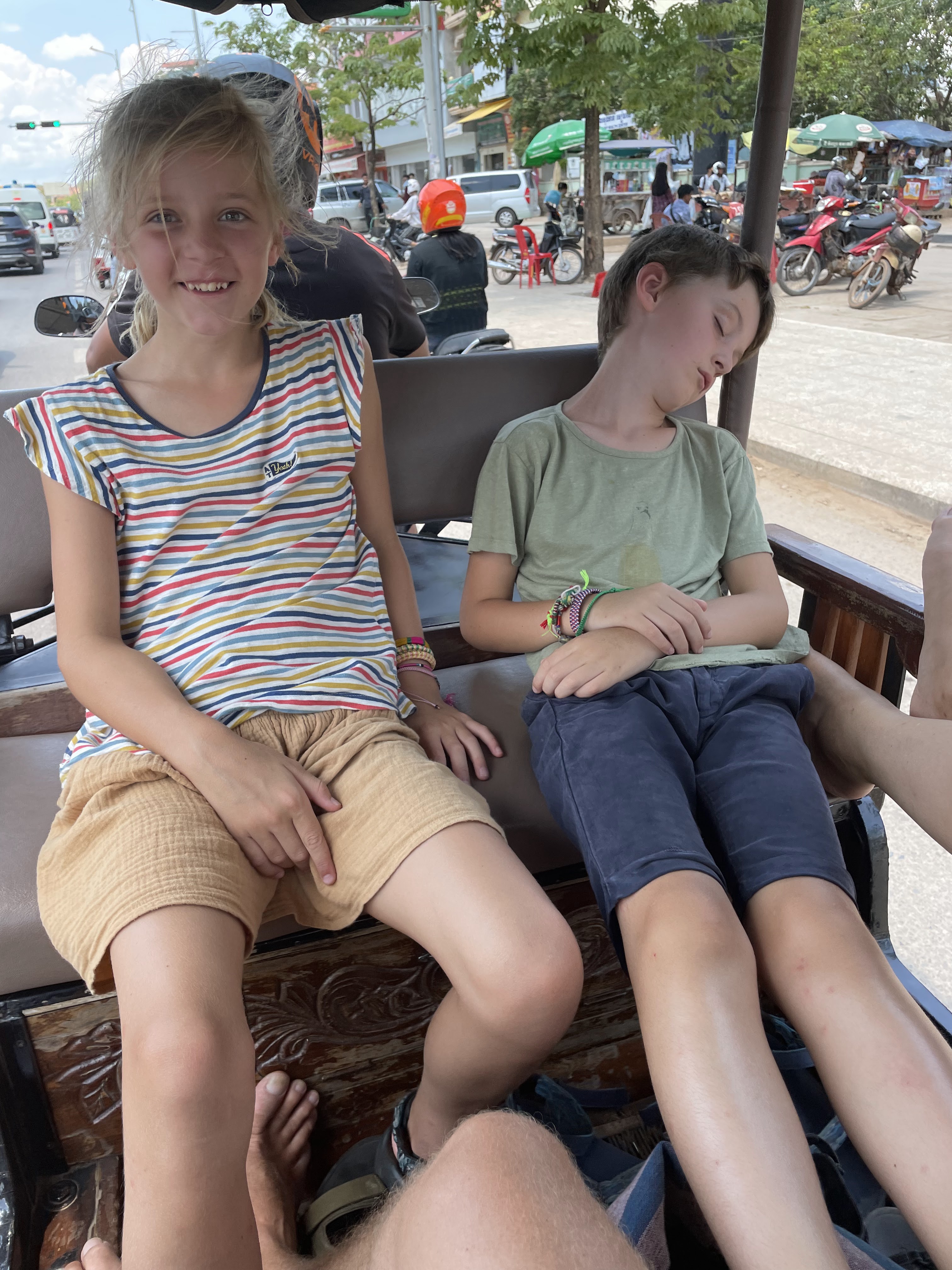
But after three days, despite the splendor of the site, we are starting to feel a bit weary of all these temples. The combination of early mornings, a packed schedule, and the extreme heat means the kids are exhausted by the evening. They’re already asleep on the restaurant sofa before we’ve even ordered. And sometimes, we can sense during the afternoon tuk-tuk rides that it’s becoming too much.
After Angkor Wat, we also visit the floating village of Kampong Phluk on the shores of Tonlé Sap, the largest freshwater lake in Asia. Now it’s time to move on, to go somewhere new. Should we head north to the mountains and the stunning hilltop temples of Preah Vihear and Prei Kuk? Or further west, to Battambang, a charming town near the border with Thailand? We haven’t decided yet.
The kids have finished their ice cream. “Where are we going tomorrow?” they ask. “We don’t know yet,” says Marie-Laure. “We’re still thinking about it.” “Oh, ok. Can we have an ice cream while we wait?”
Of course, those two never miss a beat. “Alright then. What would you like?”
Vanilla and chocolate!
 Globetrotterdammers