

People who have traveled know that the hardest part of traveling with children is finding the right pace. You don’t want to plan every day for six months if you don’t want to come home exhausted after six months. But you also want to discover these countries that we probably won’t visit again.
It’s all about balance. A rhythm. A rhythm that needs to work for both us and the kids. It’s not always easy to find. Of course, we have ideas for destinations for each day, but we deliberately leave room to adapt our daily itinerary to our mood, our energy, and the unexpected events that come our way. Sometimes, it’s just like at home: we lounge in our room or in a hammock, read on our e-reader, color or draw a bit, watch a movie or the news, drink tea, or go for a walk (for Anna and Arthur, this means looking for a beach or a playground).
For us, a day unfolds like this: waking up around seven-thirty, having a hard-boiled egg, a cucumber, and Lebanese bread with hummus for breakfast. Then it’s math, language, spelling, and geography/history for homework (until around 11 a.m.). Making plans over a cup of tea. In the afternoon, searching for a restaurant for a nice lunch. Saying “Thank you” to the server ten times. Choosing a favorite fresh juice. Reading a book. Drinking even more tea. For the kids, asking if they can play a game on the phone. For us, doing a bit of administration regarding the next part of our trip or writing about our travels and impressions. Occasionally, we need to do laundry. Preparing dinner around 7 p.m., and then heading to bed.
Traveling sometimes means not doing much and just letting the day unfold, like today. We are now in Ras al Hadd, at the southeastern tip of the Arabian Peninsula. This cape separates the Sea of Oman to the east from the Indian Ocean to the south. The Orchid Guest House, which we found yesterday with some difficulty, is a haven of peace. A large shaded terrace, the bright light and salty air of the seaside. A Bedouin tent for cool evenings and a swing to watch the shadows dance on the ground as the sun sets. We’ve happily settled in for two days. Just 100 meters away is the beach, and with the rising wind, we can hear the tumult of the waves in the distance.
This morning, we went to visit the green turtle reserve at Ras al Jinz. Oman has decided to protect these endangered turtles, which come to lay their eggs every night of the year on this beach where they themselves were born decades ago.
We wait in the night with our guide, silent and half-awake. The alarm set for 3:45 a.m. didn’t need to be turned off. Like all those nights when you know the little sleep you can get is precious, I didn’t sleep. I pondered my travel impressions all night. Suddenly, our guide receives a call. “Follow me!” We follow the beam of light. Everywhere, we see sand mounds and holes left by the turtles that come to lay their eggs night after night. We now distinctly see a smooth, dark mass laboriously making its way toward the sea. The image touches us all. It moves slowly, resting occasionally to catch its breath. It hasn’t had time to lay its eggs and has made this journey for nothing. As dawn breaks, it must return to the water. It will come back tonight and try again. The children say nothing and follow it in procession to the sea, where it disappears into the waves.
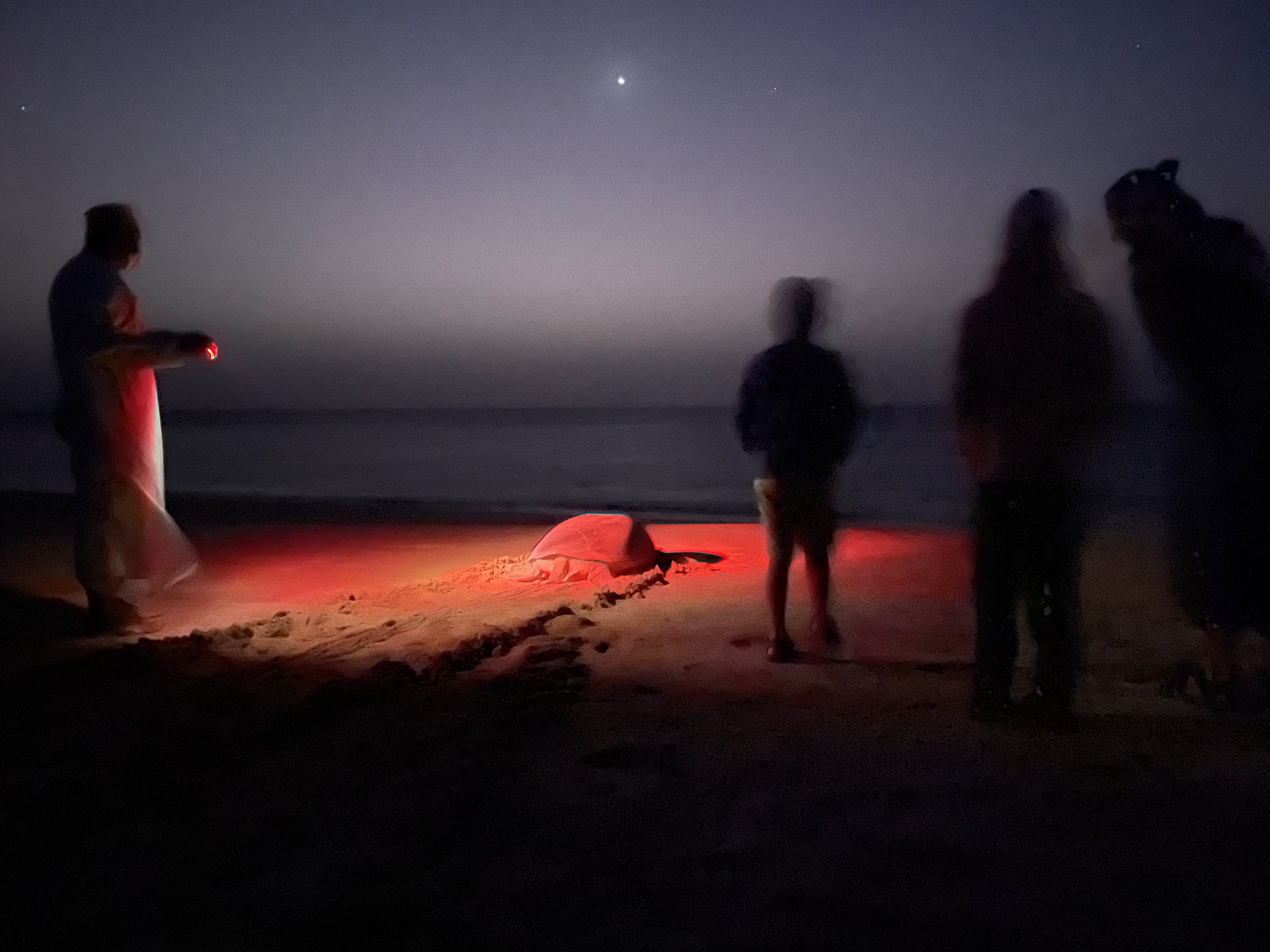
Then we wait on the beach for the sun to rise over the Indian Ocean. The kids haven’t slept much, and we start laughing and joking.
We’re accompanied by seagulls waiting for the hatchlings and a desert fox that is also hungry. But no turtles on the menu today. The fox glances at us from afar and walks away before we can tame it.
On the way back to the reserve’s visitor center, the kids ask why we didn’t help the turtle. They wonder why so few hatchlings survive after they emerge. They think the fish that eat the turtles are mean. We explain the role of these fish in maintaining the balance of nature. It’s a delicate balance that must be respected. Every animal has its role in the food chain.
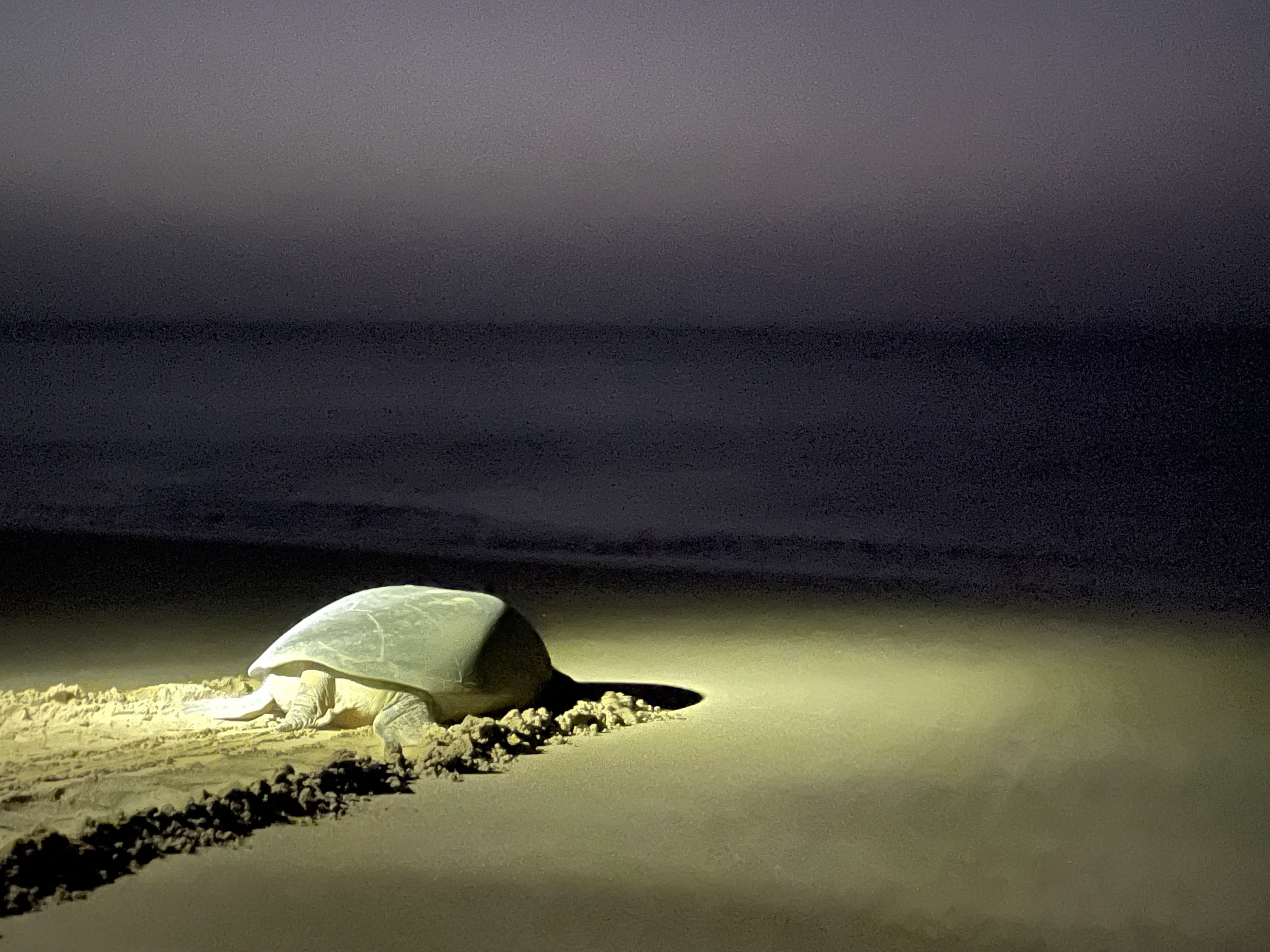
The kids are naturally attentive to animals and their fates. They observe and don’t always understand people’s attitudes toward animals. It could be a wandering donkey by the side of a Jordanian road, the scratched ear of a dog during a territorial dispute among village dogs, stray cats rummaging through enticing trash, or groups of goats in an Omani village picking up and eating whatever litter they find. Ultimately, the animals have an independent life separate from humans here. And sometimes, helping means doing nothing.
At 8 a.m., we’re back home. There’s nothing else on the agenda. We lounge around, take a little nap, drink tea, and read in the hammock. It’s a pace as slow as that of the turtle making its way back to the sea.
And, if it were up to Anna and Arthur, perhaps a little trip to the playground.
 Globetrotterdammers